Describe the experimental rationale that allowed the lac repressor to be isolated.
Table of contents
- 1. Introduction to Genetics51m
- 2. Mendel's Laws of Inheritance3h 37m
- 3. Extensions to Mendelian Inheritance2h 41m
- 4. Genetic Mapping and Linkage2h 28m
- 5. Genetics of Bacteria and Viruses1h 21m
- 6. Chromosomal Variation1h 48m
- 7. DNA and Chromosome Structure56m
- 8. DNA Replication1h 10m
- 9. Mitosis and Meiosis1h 34m
- 10. Transcription1h 0m
- 11. Translation58m
- 12. Gene Regulation in Prokaryotes1h 19m
- 13. Gene Regulation in Eukaryotes44m
- 14. Genetic Control of Development44m
- 15. Genomes and Genomics1h 50m
- 16. Transposable Elements47m
- 17. Mutation, Repair, and Recombination1h 6m
- 18. Molecular Genetic Tools19m
- 19. Cancer Genetics29m
- 20. Quantitative Genetics1h 26m
- 21. Population Genetics50m
- 22. Evolutionary Genetics29m
12. Gene Regulation in Prokaryotes
Lac Operon
Problem 10
Textbook Question
Predict the effect on the inducibility of the lac operon of a mutation that disrupts the function of:
(a) The CRP gene, which encodes the CAP protein
(b) The CAP-binding site within the promoter.
Verified step by step guidance1
Step 1: Understand the role of the CRP gene and CAP protein in the lac operon. The CRP gene encodes the CAP protein, which acts as a positive regulator by binding to the CAP-binding site near the lac promoter to enhance transcription when glucose levels are low.
Step 2: For part (a), analyze the effect of a mutation that disrupts the CRP gene function. Without functional CAP protein, the positive regulation of the lac operon is lost, so even when lactose is present and glucose is low, the operon induction will be reduced.
Step 3: For part (b), consider the mutation in the CAP-binding site within the promoter. Even if CAP protein is present, it cannot bind to the promoter to stimulate transcription, leading to a similar reduction in inducibility as in part (a).
Step 4: Compare the effects of both mutations on lac operon inducibility. Both mutations impair the positive regulation by CAP, so the lac operon will have lower expression levels in the presence of lactose and absence of glucose compared to the wild type.
Step 5: Summarize that the inducibility of the lac operon depends on CAP binding to its site; disruption of either the CAP protein or its binding site reduces the operon's ability to be induced efficiently.
Verified video answer for a similar problem:This video solution was recommended by our tutors as helpful for the problem above
Video duration:
2mPlay a video:
Was this helpful?
Key Concepts
Here are the essential concepts you must grasp in order to answer the question correctly.
Lac Operon Regulation
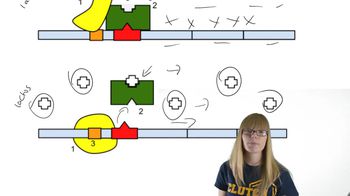
The lac operon is a set of genes involved in lactose metabolism in E. coli, regulated by proteins that respond to environmental signals. Its expression is controlled by the presence or absence of lactose and glucose, allowing the cell to efficiently use available sugars.
Recommended video:
Guided course
Lac Operon Regulation
Role of CAP (Catabolite Activator Protein)
CAP is a regulatory protein that, when bound to cAMP, enhances transcription of the lac operon by facilitating RNA polymerase binding. It acts as an activator in low-glucose conditions, increasing operon inducibility by promoting gene expression.
Recommended video:
Guided course
Proteins
CAP-Binding Site Function
The CAP-binding site is a specific DNA sequence near the lac promoter where the CAP-cAMP complex binds. This binding is essential for the positive regulation of the lac operon, as it helps recruit RNA polymerase and increases transcription efficiency.
Recommended video:
Guided course
Functional Genomics
Related Videos
Related Practice
Textbook Question
918
views
