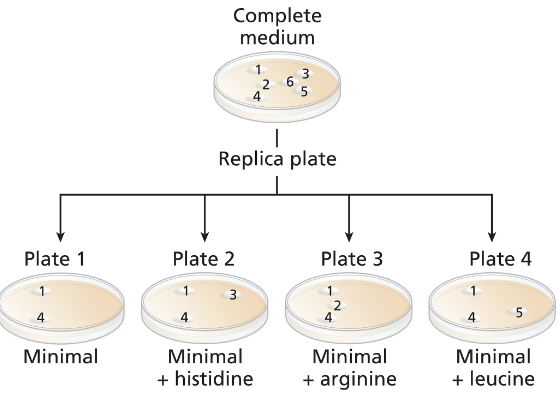
A wild-type culture of haploid yeast is exposed to ethyl methanesulfonate (EMS). Yeast cells are plated on a complete medium, and 6 colonies (colonies numbered 1 to 6) are transferred to a new complete medium plate for further study. Four replica plates are made from the complete medium plate to plates containing minimal medium or minimal medium plus one amino acid (replica plates numbered 1 to 4) with the following results: Identify the colonies that are prototrophic (wild type). What growth information leads to your answer?
Verified step by step guidance
1
Understand the problem: The question involves identifying prototrophic (wild-type) yeast colonies after exposing haploid yeast to EMS, a mutagen. Prototrophic colonies can grow on minimal medium without requiring additional nutrients, as they can synthesize all necessary compounds themselves.
Analyze the experimental setup: Colonies were grown on a complete medium plate, which contains all nutrients. Replica plates were made from this plate, including minimal medium plates and minimal medium plates supplemented with specific amino acids. Growth patterns on these plates will help determine which colonies are prototrophic.
Interpret the growth data: Examine the growth patterns of colonies on the minimal medium plate. Prototrophic colonies will grow on minimal medium because they do not require additional nutrients. Colonies that fail to grow on minimal medium but grow on supplemented plates are auxotrophic (mutants).
Identify prototrophic colonies: Look for colonies that grow on the minimal medium plate (replica plate 1). These colonies are wild-type because they can synthesize all necessary compounds without supplementation.
Explain the reasoning: The growth on minimal medium indicates that the colony retains the ability to synthesize all essential compounds, which is characteristic of prototrophic (wild-type) yeast. Colonies that require supplementation on other plates are auxotrophic mutants, likely due to mutations induced by EMS.
Verified video answer for a similar problem:
This video solution was recommended by our tutors as helpful for the problem above
Video duration:
3m
Play a video:
Was this helpful?
Key Concepts
Here are the essential concepts you must grasp in order to answer the question correctly.
Prototrophy vs. Auxotrophy
Prototrophic organisms can synthesize all the compounds they need for growth from basic nutrients, while auxotrophic organisms lack the ability to produce certain compounds and require them to be supplied in the medium. In the context of yeast, identifying whether a colony is prototrophic or auxotrophic is crucial for understanding its growth on minimal media.
Minimal medium contains only the essential nutrients required for the growth of prototrophic organisms, such as carbon, nitrogen, and salts. Auxotrophic mutants, which cannot synthesize certain nutrients, will not grow on minimal medium unless the missing nutrient is added. This concept is key to determining which yeast colonies are prototrophic based on their growth patterns.
Replica plating is a technique used to transfer colonies from one agar plate to another, allowing for the comparison of growth under different conditions. This method helps identify auxotrophic mutants by observing their growth on minimal media versus complete media, providing insights into their nutritional requirements and metabolic capabilities.