After completing Problem 17, carefully draw a line below the mRNA to represent its polypeptide product in accurate alignment with the mRNA. Label the N-terminal and C-terminal ends of the polypeptide. Carefully draw two lines above and parallel to the mRNA, and label them 'coding strand' and 'template strand.' Locate the DNA promoter sequence. Identify the locations of the nucleotide and of a transcription termination sequence.
Table of contents
- 1. Introduction to Genetics51m
- 2. Mendel's Laws of Inheritance3h 37m
- 3. Extensions to Mendelian Inheritance2h 41m
- 4. Genetic Mapping and Linkage2h 28m
- 5. Genetics of Bacteria and Viruses1h 21m
- 6. Chromosomal Variation1h 48m
- 7. DNA and Chromosome Structure56m
- 8. DNA Replication1h 10m
- 9. Mitosis and Meiosis1h 34m
- 10. Transcription1h 0m
- 11. Translation58m
- 12. Gene Regulation in Prokaryotes1h 19m
- 13. Gene Regulation in Eukaryotes44m
- 14. Genetic Control of Development44m
- 15. Genomes and Genomics1h 50m
- 16. Transposable Elements47m
- 17. Mutation, Repair, and Recombination1h 6m
- 18. Molecular Genetic Tools19m
- 19. Cancer Genetics29m
- 20. Quantitative Genetics1h 26m
- 21. Population Genetics50m
- 22. Evolutionary Genetics29m
11. Translation
Translation
Problem 35
Textbook Question
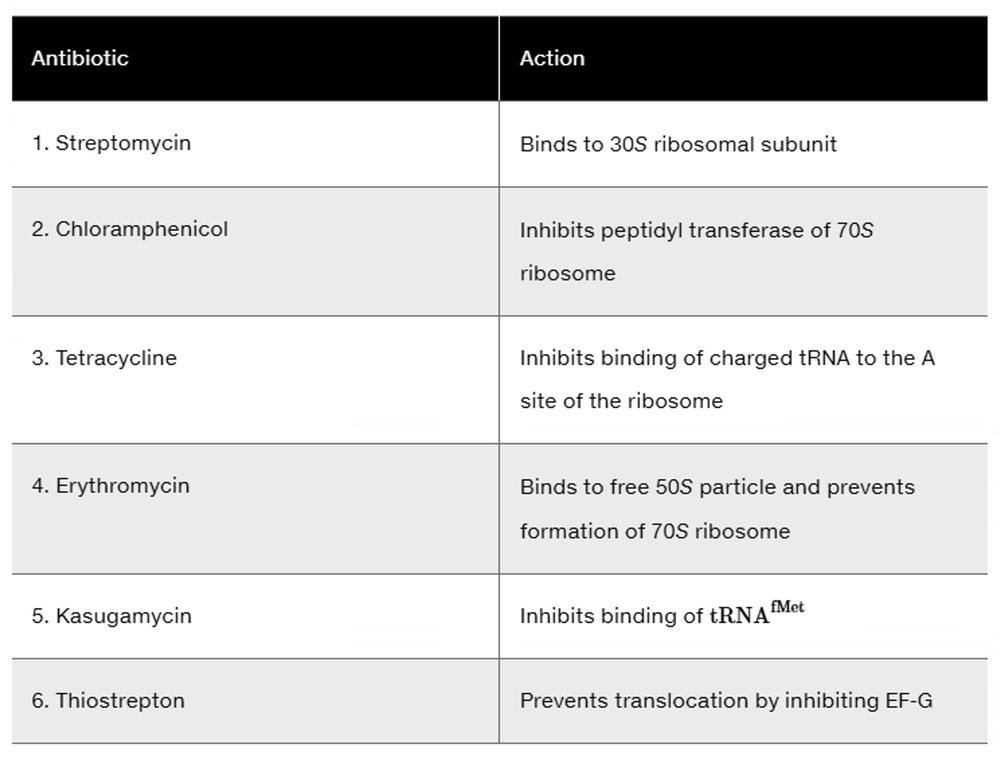
Many antibiotics are effective as drugs to fight off bacterial infections because they inhibit protein synthesis in bacterial cells. Using the information provided in the following table that highlights several antibiotics and their mode of action, discuss which phase of translation is inhibited: initiation, elongation, or termination. What other components of the translational machinery could be targeted to inhibit bacterial protein synthesis?

Verified step by step guidance1
Review the phases of translation: initiation (assembly of the ribosome on mRNA and start codon recognition), elongation (addition of amino acids to the growing polypeptide chain), and termination (release of the completed polypeptide when a stop codon is reached).
Examine the mode of action of each antibiotic listed in the table to determine which specific step of translation it affects. For example, if an antibiotic prevents the formation of the initiation complex, it inhibits initiation; if it blocks the movement of the ribosome along mRNA or the addition of amino acids, it inhibits elongation; if it interferes with release factors or ribosome disassembly, it inhibits termination.
Identify the molecular targets of these antibiotics, such as the 30S or 50S ribosomal subunits, tRNA binding sites (A, P, or E sites), or factors involved in translation (e.g., initiation factors, elongation factors, or release factors).
Discuss other components of the translational machinery that could be targeted to inhibit bacterial protein synthesis, such as aminoacyl-tRNA synthetases (which charge tRNAs with amino acids), ribosomal RNA, or specific translation factors unique to bacteria.
Summarize how targeting different phases or components of translation can effectively inhibit bacterial protein synthesis and why this specificity is important for antibiotic function.
Verified video answer for a similar problem:This video solution was recommended by our tutors as helpful for the problem above
Video duration:
1mPlay a video:
Was this helpful?
Key Concepts
Here are the essential concepts you must grasp in order to answer the question correctly.
Phases of Translation
Translation is the process of protein synthesis and occurs in three main phases: initiation, elongation, and termination. Initiation involves assembly of the ribosome on mRNA and the start tRNA, elongation adds amino acids to the growing polypeptide chain, and termination releases the completed protein when a stop codon is reached.
Recommended video:
Guided course
Translation initiation
Mechanism of Antibiotic Action on Translation
Many antibiotics inhibit bacterial protein synthesis by targeting specific steps in translation. For example, some block initiation by preventing ribosome assembly, others inhibit elongation by interfering with tRNA binding or peptide bond formation, and some affect termination by disrupting release factors. Understanding these mechanisms helps identify which phase is inhibited.
Recommended video:
Guided course
Translation initiation
Components of the Translational Machinery as Drug Targets
The translational machinery includes ribosomal subunits, mRNA, tRNAs, aminoacyl-tRNA synthetases, and various translation factors. Antibiotics can target any of these components to inhibit protein synthesis, such as binding to the 30S or 50S ribosomal subunits, blocking tRNA charging, or interfering with elongation factors, thereby halting bacterial growth.
Recommended video:
Guided course
Translation initiation
Watch next
Master Translation initiation with a bite sized video explanation from Kylia
Start learningRelated Videos
Related Practice
Textbook Question
705
views
