Tay–Sachs disease is an autosomal recessive neurological disorder that is fatal in infancy. Despite its invariably lethal effect, Tay–Sachs disease occurs at very high frequency in some Central and Eastern European (Ashkenazi) Jewish populations. In certain Ashkenazi populations, 1 in 750 infants has Tay–Sachs disease. Population biologists believe the high frequency is a consequence of genetic bottlenecks caused by pogroms (genocide) that have reduced the population multiple times in the past several hundred years. Assuming mating occurs at random in this population, what is the probability a couple are both carriers of Tay–Sachs disease?
Table of contents
- 1. Introduction to Genetics51m
- 2. Mendel's Laws of Inheritance3h 37m
- 3. Extensions to Mendelian Inheritance2h 41m
- 4. Genetic Mapping and Linkage2h 28m
- 5. Genetics of Bacteria and Viruses1h 21m
- 6. Chromosomal Variation1h 48m
- 7. DNA and Chromosome Structure56m
- 8. DNA Replication1h 10m
- 9. Mitosis and Meiosis1h 34m
- 10. Transcription1h 0m
- 11. Translation58m
- 12. Gene Regulation in Prokaryotes1h 19m
- 13. Gene Regulation in Eukaryotes44m
- 14. Genetic Control of Development44m
- 15. Genomes and Genomics1h 50m
- 16. Transposable Elements47m
- 17. Mutation, Repair, and Recombination1h 6m
- 18. Molecular Genetic Tools19m
- 19. Cancer Genetics29m
- 20. Quantitative Genetics1h 26m
- 21. Population Genetics50m
- 22. Evolutionary Genetics29m
21. Population Genetics
Allelic Frequency Changes
Problem 22
Textbook Question
To increase genetic diversity in the bighorn sheep population described in Problem 23, ten sheep are introduced from a population where the c allele is absent. Assuming that random mating occurs between the original and the introduced sheep, and that the c allele is selectively neutral, what will be the frequency of c in the next generation?
Verified step by step guidance1
Identify the initial frequency of the c allele in the original bighorn sheep population from Problem 23. This frequency is usually denoted as \(p_c\) or \(f(c)\).
Determine the allele frequencies in the introduced population. Since the c allele is absent there, the frequency of c in the introduced sheep is 0.
Calculate the combined allele frequency of c in the mixed population after introducing the ten sheep. Use a weighted average based on the number of individuals in each group. If \(N_o\) is the number of original sheep and \(N_i = 10\) is the number of introduced sheep, then the new frequency \(f'(c)\) is given by:
\[f'(c) = \frac{N_o \times f(c) + N_i \times 0}{N_o + N_i}\]
Since the c allele is selectively neutral, assume no selection affects allele frequencies between generations, so the frequency of c in the next generation remains \(f'(c)\).
Summarize that the frequency of c in the next generation is the weighted average of the original frequency and zero from the introduced sheep, reflecting random mating and no selection.
Verified video answer for a similar problem:This video solution was recommended by our tutors as helpful for the problem above
Video duration:
2mPlay a video:
Was this helpful?
Key Concepts
Here are the essential concepts you must grasp in order to answer the question correctly.
Allele Frequency
Allele frequency refers to how common a particular allele is in a population's gene pool. It is calculated as the proportion of all copies of a gene that are a specific allele. Understanding allele frequency helps predict genetic variation and evolutionary changes over generations.
Recommended video:
Guided course
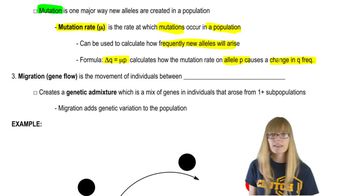
New Alleles and Migration
Gene Flow and Population Mixing
Gene flow occurs when individuals from different populations interbreed, introducing new alleles into a population. This mixing can alter allele frequencies and increase genetic diversity, especially when migrants carry alleles absent in the original population.
Recommended video:
Guided course
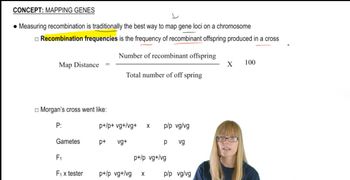
Mapping Genes
Selective Neutrality
A selectively neutral allele does not affect an organism's fitness, meaning it neither increases nor decreases survival or reproduction. Such alleles change frequency mainly through genetic drift or gene flow rather than natural selection.
Recommended video:
Guided course
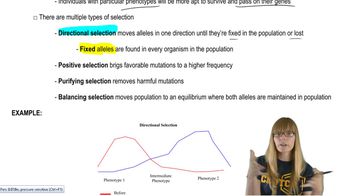
Natural Selection
Related Videos
Related Practice
Textbook Question
428
views
