To increase genetic diversity in the bighorn sheep population described in Problem 23, ten sheep are introduced from a population where the c allele is absent. Assuming that random mating occurs between the original and the introduced sheep, and that the c allele is selectively neutral, what will be the frequency of c in the next generation?
Table of contents
- 1. Introduction to Genetics51m
- 2. Mendel's Laws of Inheritance3h 37m
- 3. Extensions to Mendelian Inheritance2h 41m
- 4. Genetic Mapping and Linkage2h 28m
- 5. Genetics of Bacteria and Viruses1h 21m
- 6. Chromosomal Variation1h 48m
- 7. DNA and Chromosome Structure56m
- 8. DNA Replication1h 10m
- 9. Mitosis and Meiosis1h 34m
- 10. Transcription1h 0m
- 11. Translation58m
- 12. Gene Regulation in Prokaryotes1h 19m
- 13. Gene Regulation in Eukaryotes44m
- 14. Genetic Control of Development44m
- 15. Genomes and Genomics1h 50m
- 16. Transposable Elements47m
- 17. Mutation, Repair, and Recombination1h 6m
- 18. Molecular Genetic Tools19m
- 19. Cancer Genetics29m
- 20. Quantitative Genetics1h 26m
- 21. Population Genetics50m
- 22. Evolutionary Genetics29m
21. Population Genetics
Allelic Frequency Changes
Problem 28
Textbook Question
The original source of new alleles, upon which selection operates, is mutation, a random event that occurs without regard to selectional value in the organism. Although many model organisms have been used to study mutational events in populations, some investigators have developed abiotic molecular models. Soll et al. (2006. Genetics 175: 267-275) examined one such model to study the relationship between both deleterious and advantageous mutations and population size in a ligase molecule composed of RNA (a ribozyme). Soll found that the smaller the population of molecules, the more likely it was that not only deleterious mutations but also advantageous mutations would disappear. Why would population size influence the survival of both types of mutations (deleterious and advantageous) in populations?
Verified step by step guidance1
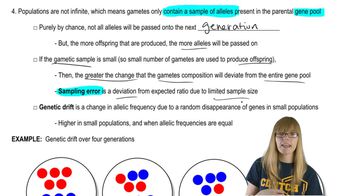
Understand that population size affects genetic drift, which is the random fluctuation of allele frequencies in a population independent of natural selection.
Recognize that in small populations, genetic drift has a stronger effect, causing alleles (both deleterious and advantageous) to be lost or fixed by chance more rapidly than in large populations.
Consider that advantageous mutations, although beneficial, can be lost in small populations because the random sampling effect can override the selective advantage.
Similarly, deleterious mutations might also be lost quickly in small populations due to drift, but sometimes they can become fixed if selection is weak and drift is strong.
Conclude that population size influences the survival of mutations because in small populations, random chance (genetic drift) plays a larger role than selection, affecting the fate of both deleterious and advantageous mutations.
Verified video answer for a similar problem:This video solution was recommended by our tutors as helpful for the problem above
Video duration:
4mPlay a video:
Was this helpful?
Key Concepts
Here are the essential concepts you must grasp in order to answer the question correctly.
Mutation as a Source of Genetic Variation
Mutations are random changes in the genetic material that create new alleles, providing the raw material for evolution. They can be neutral, deleterious, or advantageous, and occur independently of an organism’s fitness. Understanding mutation is essential because it introduces genetic diversity upon which natural selection and genetic drift act.
Recommended video:
Guided course
Genomic Variation
Genetic Drift and Population Size
Genetic drift is the random fluctuation of allele frequencies in a population, which has a stronger effect in small populations. In small populations, chance events can lead to the loss or fixation of alleles regardless of their selective advantage or disadvantage, causing both beneficial and harmful mutations to disappear more easily.
Recommended video:
Guided course
Genetic Drift
Natural Selection vs. Random Effects in Evolution
Natural selection favors advantageous mutations and removes deleterious ones based on their impact on fitness. However, in small populations, random effects like genetic drift can overpower selection, making survival of mutations less dependent on their selective value and more on chance, explaining why both types of mutations may be lost.
Recommended video:
Guided course
Natural Selection
Related Videos
Related Practice
Textbook Question
561
views