Table of contents
- 1. Introduction to Genetics51m
- 2. Mendel's Laws of Inheritance3h 37m
- 3. Extensions to Mendelian Inheritance2h 41m
- 4. Genetic Mapping and Linkage2h 28m
- 5. Genetics of Bacteria and Viruses1h 21m
- 6. Chromosomal Variation1h 48m
- 7. DNA and Chromosome Structure56m
- 8. DNA Replication1h 10m
- 9. Mitosis and Meiosis1h 34m
- 10. Transcription1h 0m
- 11. Translation58m
- 12. Gene Regulation in Prokaryotes1h 19m
- 13. Gene Regulation in Eukaryotes44m
- 14. Genetic Control of Development44m
- 15. Genomes and Genomics1h 50m
- 16. Transposable Elements47m
- 17. Mutation, Repair, and Recombination1h 6m
- 18. Molecular Genetic Tools19m
- 19. Cancer Genetics29m
- 20. Quantitative Genetics1h 26m
- 21. Population Genetics50m
- 22. Evolutionary Genetics29m
2. Mendel's Laws of Inheritance
Pedigrees
Problem 30b
Textbook Question
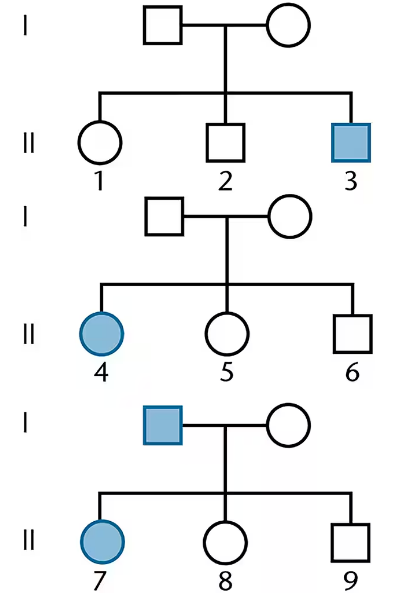
Consider the three pedigrees below, all involving a single human trait.

For each combination that you excluded, indicate the single individual in generation II (e.g., II-1, II-2) that was most instrumental in your decision to exclude it. If none were excluded, answer 'none apply.'
Verified step by step guidance1
Step 1: Identify the trait pattern in each pedigree by noting which individuals are affected (shaded) and which are unaffected (unshaded). This helps determine if the trait is dominant or recessive.
Step 2: For each pedigree, analyze the inheritance pattern by considering the genotypes of the parents (generation I) and their offspring (generation II). Use the rules of Mendelian inheritance to predict possible genotypes.
Step 3: Check for inconsistencies in each pedigree. For example, if the trait is dominant, an affected individual must have at least one affected parent. If this is not the case, exclude that inheritance pattern and identify the individual in generation II who contradicts it.
Step 4: For recessive traits, ensure that affected individuals have parents who are either carriers or affected. If an affected individual has two unaffected parents who cannot be carriers, exclude that pattern and identify the key individual in generation II.
Step 5: Summarize your exclusions by listing the specific individual in generation II from each pedigree that led to the exclusion of a particular inheritance pattern. If no contradictions are found, state 'none apply.'
Verified video answer for a similar problem:This video solution was recommended by our tutors as helpful for the problem above
Video duration:
4mPlay a video:
Was this helpful?
Key Concepts
Here are the essential concepts you must grasp in order to answer the question correctly.
Pedigree Analysis
Pedigree analysis is a tool used to study the inheritance patterns of traits through generations in a family. It uses standardized symbols to represent individuals and their traits, helping to determine whether a trait is dominant, recessive, autosomal, or sex-linked. Understanding how to interpret these symbols and relationships is essential for analyzing genetic inheritance.
Recommended video:
Guided course
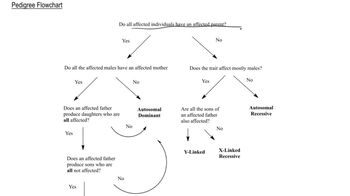
Pedigree Flowchart
Modes of Inheritance
Modes of inheritance describe how traits are passed from parents to offspring, including autosomal dominant, autosomal recessive, X-linked dominant, and X-linked recessive patterns. Each mode has distinct characteristics, such as affected individuals appearing in every generation for dominant traits or skipping generations for recessive traits, which are critical for excluding or confirming possible inheritance patterns in pedigrees.
Recommended video:
Guided course
Organelle Inheritance
Genotype-Phenotype Correlation in Pedigrees
Genotype-phenotype correlation involves linking the observed traits (phenotypes) in a pedigree to the underlying genetic makeup (genotypes). Identifying which individuals must carry or lack certain alleles based on their phenotype helps exclude incompatible inheritance patterns. This concept is key to pinpointing individuals in generation II who are instrumental in ruling out specific genetic models.
Recommended video:
Guided course
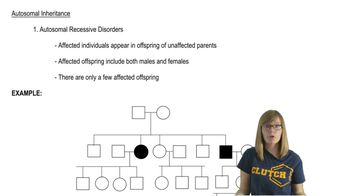
Autosomal Pedigrees
Related Videos
Related Practice
Textbook Question
For decades scientists have been perplexed by different circumstances surrounding families with rare, early-onset auditory neuropathy (deafness). In some families, parents and grandparents of the proband have normal hearing, while in other families, a number of affected (deaf) family members are scattered throughout the pedigree, appearing in every generation. Assuming a genetic cause for each case, offer a reasonable explanation for the genetic origin of such deafness in the two types of families.
552
views
