The narrow-sense heritability of the number of seeds per flower is 0.9. The mean of the population is 6.0 seeds per flower. A flower breeder crosses one flower with 7 seeds to another plant with 9 seeds. What is the expected number of seeds per flower in the offspring of this cross?
Table of contents
- 1. Introduction to Genetics51m
- 2. Mendel's Laws of Inheritance3h 37m
- 3. Extensions to Mendelian Inheritance2h 41m
- 4. Genetic Mapping and Linkage2h 28m
- 5. Genetics of Bacteria and Viruses1h 21m
- 6. Chromosomal Variation1h 48m
- 7. DNA and Chromosome Structure56m
- 8. DNA Replication1h 10m
- 9. Mitosis and Meiosis1h 34m
- 10. Transcription1h 0m
- 11. Translation58m
- 12. Gene Regulation in Prokaryotes1h 19m
- 13. Gene Regulation in Eukaryotes44m
- 14. Genetic Control of Development44m
- 15. Genomes and Genomics1h 50m
- 16. Transposable Elements47m
- 17. Mutation, Repair, and Recombination1h 6m
- 18. Molecular Genetic Tools19m
- 19. Cancer Genetics29m
- 20. Quantitative Genetics1h 26m
- 21. Population Genetics50m
- 22. Evolutionary Genetics29m
20. Quantitative Genetics
Heritability
Problem 7b
Textbook Question
Erma and Harvey were a compatible barnyard pair, but a curious sight. Harvey's tail was only 6 cm long, while Erma's was 30 cm. Their F₁ piglet offspring all grew tails that were 18 cm. When inbred, an F₂ generation resulted in many piglets (Erma and Harvey's grandpigs), whose tails ranged in 4-cm intervals from 6 to 30 cm (6, 10, 14, 18, 22, 26, and 30). Most had 18-cm tails, while 1/64 had 6-cm tails and 1/64 had 30-cm tails.
If one of the 18-cm-tail F₁ pigs is mated with one of the 6-cm-tail F₂ pigs, what phenotypic ratio will be predicted if many offspring resulted? Diagram the cross.
Verified step by step guidance1
Step 1: Identify the inheritance pattern. The tail length varies in 4-cm intervals and the F1 offspring have an intermediate tail length (18 cm) between the parents (6 cm and 30 cm). This suggests incomplete dominance with multiple alleles or additive gene action, where tail length is determined by the sum of alleles from each parent.
Step 2: Assign genotypes to the parents. Let’s denote alleles corresponding to tail length increments. For example, assign 'A' alleles contributing 6 cm each. Harvey (6 cm) would be homozygous for the smallest allele (e.g., aa), Erma (30 cm) homozygous for the largest (e.g., AA), and the F1 (18 cm) heterozygous (e.g., Aa). The F2 generation shows a 1:6:15:20:15:6:1 distribution, consistent with a trinomial expansion of a three-allele system or multiple additive loci.
Step 3: Determine the genotype of the 6-cm-tail F2 pig. Since 6 cm is the smallest tail length, this pig is likely homozygous for the smallest allele (aa). The 18-cm F1 pig is heterozygous (Aa).
Step 4: Set up the Punnett square for the cross between the 18-cm F1 pig (Aa) and the 6-cm F2 pig (aa). The possible gametes from Aa are A and a; from aa, only a. The offspring genotypes will be Aa and aa.
Step 5: Predict the phenotypic ratio. Since Aa corresponds to 18 cm and aa to 6 cm, the offspring will be 50% 18-cm tails and 50% 6-cm tails. Diagram the cross showing the gametes and resulting genotypes to visualize this ratio.
Verified video answer for a similar problem:This video solution was recommended by our tutors as helpful for the problem above
Video duration:
2mPlay a video:
Was this helpful?
Key Concepts
Here are the essential concepts you must grasp in order to answer the question correctly.
Incomplete Dominance and Quantitative Traits
Incomplete dominance occurs when heterozygotes display an intermediate phenotype between the two homozygotes, as seen in the F₁ piglets with 18 cm tails. Quantitative traits, like tail length here, are controlled by multiple alleles or gene copies, producing a range of phenotypes in the offspring rather than discrete categories.
Recommended video:
Guided course
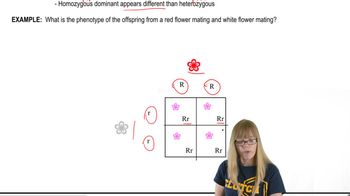
Variations on Dominance
Polygenic Inheritance and Additive Gene Effects
Polygenic inheritance involves multiple genes contributing additively to a trait, resulting in continuous variation such as the 4-cm interval tail lengths in the F₂ generation. Each gene adds a small effect, and the combination of alleles determines the phenotype, explaining the range and frequency distribution observed.
Recommended video:
Guided course
Maternal Effect
Punnett Square and Predicting Phenotypic Ratios
A Punnett square is a tool to diagram genetic crosses and predict offspring genotypes and phenotypes. By assigning alleles to represent tail length contributions, one can cross an 18-cm F₁ pig with a 6-cm F₂ pig to calculate expected phenotypic ratios based on allele combinations and additive effects.
Recommended video:
Guided course
Chi Square Analysis
Watch next
Master Calculating Heritability with a bite sized video explanation from Kylia
Start learningRelated Videos
Related Practice
Multiple Choice
401
views
