The effect of base-pair substitution mutations on protein function varies widely from no detectable effect to the complete loss of protein function (null allele). Why do the functional consequences of base-pair substitution vary so widely?
Table of contents
- 1. Introduction to Genetics51m
- 2. Mendel's Laws of Inheritance3h 37m
- 3. Extensions to Mendelian Inheritance2h 41m
- 4. Genetic Mapping and Linkage2h 28m
- 5. Genetics of Bacteria and Viruses1h 21m
- 6. Chromosomal Variation1h 48m
- 7. DNA and Chromosome Structure56m
- 8. DNA Replication1h 10m
- 9. Mitosis and Meiosis1h 34m
- 10. Transcription1h 0m
- 11. Translation58m
- 12. Gene Regulation in Prokaryotes1h 19m
- 13. Gene Regulation in Eukaryotes44m
- 14. Genetic Control of Development44m
- 15. Genomes and Genomics1h 50m
- 16. Transposable Elements47m
- 17. Mutation, Repair, and Recombination1h 6m
- 18. Molecular Genetic Tools19m
- 19. Cancer Genetics29m
- 20. Quantitative Genetics1h 26m
- 21. Population Genetics50m
- 22. Evolutionary Genetics29m
17. Mutation, Repair, and Recombination
Types of Mutations
Problem 9
Textbook Question
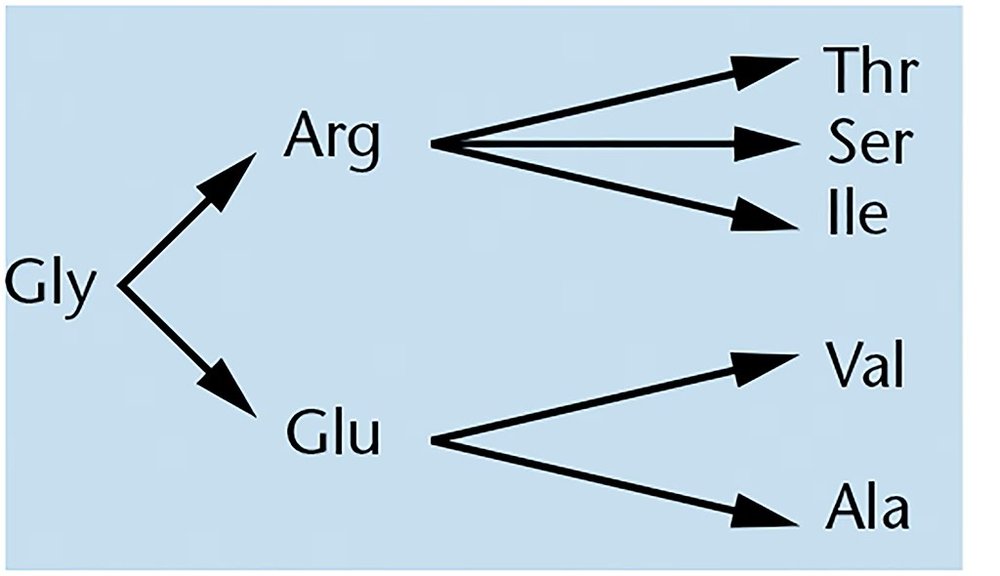
In studies of the amino acid sequence of wild-type and mutant forms of tryptophan synthetase in E. coli, the following changes have been observed:

Determine a set of triplet codes in which only a single-nucleotide change produces each amino acid change.
Verified step by step guidance1
Step 1: Identify the starting amino acid and its codons. Here, the starting amino acid is Glycine (Gly). Begin by listing all possible codons for Glycine, which are GGU, GGC, GGA, and GGG. These codons differ mainly in the third nucleotide position.
Step 2: Determine codons for the first set of amino acids (Arginine and Glutamic acid) that can be reached from Glycine codons by a single-nucleotide change. For each Gly codon, consider changing one nucleotide at a time to form a codon for Arg or Glu. This involves checking the genetic code table to find codons for Arg and Glu that differ by only one nucleotide from Gly codons.
Step 3: For the second set of amino acids (Thr, Ser, Ile from Arg; Val, Ala from Glu), identify codons that differ by only one nucleotide from the Arg and Glu codons found in Step 2. This means for each Arg and Glu codon, change one nucleotide to get codons for Thr, Ser, Ile, Val, or Ala, respectively.
Step 4: Verify that each amino acid change requires only a single-nucleotide substitution by comparing the codons side-by-side and confirming only one base differs between the original and mutated codons.
Step 5: Compile the set of codons for Gly, Arg, Glu, Thr, Ser, Ile, Val, and Ala that satisfy the single-nucleotide change condition. This set represents the triplet codes where each amino acid change can be produced by a single-nucleotide mutation.
Verified video answer for a similar problem:This video solution was recommended by our tutors as helpful for the problem above
Video duration:
1mPlay a video:
Was this helpful?
Key Concepts
Here are the essential concepts you must grasp in order to answer the question correctly.
Genetic Code and Codon Structure
The genetic code consists of triplet codons, each made of three nucleotides, that specify amino acids during protein synthesis. Understanding how single-nucleotide changes (point mutations) in these codons can alter the encoded amino acid is essential for predicting mutation effects. Codon redundancy and specificity influence which amino acid substitutions are possible with minimal nucleotide changes.
Recommended video:
Guided course
The Genetic Code
Single-Nucleotide Mutations and Their Effects
Single-nucleotide mutations involve the substitution of one nucleotide in a codon, potentially changing the encoded amino acid. These mutations can be silent, missense, or nonsense, depending on their impact. In this question, identifying codons where a single-nucleotide change leads to specific amino acid substitutions is crucial for mapping mutation pathways.
Recommended video:
Guided course
Maternal Effect
Amino Acid Properties and Mutation Pathways
Amino acids differ in chemical properties such as charge, polarity, and size, which affect protein function. The question involves mutations from Glycine (Gly) to Arginine (Arg) or Glutamic acid (Glu), then to other amino acids via single-nucleotide changes. Understanding these relationships helps in selecting codons that allow stepwise single-nucleotide mutations producing the observed amino acid changes.
Recommended video:
Guided course
Point Mutations
Related Videos
Related Practice
Textbook Question
558
views
