Discuss the concepts of homologous chromosomes, diploidy, and haploidy. What characteristics do two homologous chromosomes share?
Table of contents
- 1. Introduction to Genetics51m
- 2. Mendel's Laws of Inheritance3h 37m
- 3. Extensions to Mendelian Inheritance2h 41m
- 4. Genetic Mapping and Linkage2h 28m
- 5. Genetics of Bacteria and Viruses1h 21m
- 6. Chromosomal Variation1h 48m
- 7. DNA and Chromosome Structure56m
- 8. DNA Replication1h 10m
- 9. Mitosis and Meiosis1h 34m
- 10. Transcription1h 0m
- 11. Translation58m
- 12. Gene Regulation in Prokaryotes1h 19m
- 13. Gene Regulation in Eukaryotes44m
- 14. Genetic Control of Development44m
- 15. Genomes and Genomics1h 50m
- 16. Transposable Elements47m
- 17. Mutation, Repair, and Recombination1h 6m
- 18. Molecular Genetic Tools19m
- 19. Cancer Genetics29m
- 20. Quantitative Genetics1h 26m
- 21. Population Genetics50m
- 22. Evolutionary Genetics29m
9. Mitosis and Meiosis
Mitosis
Problem 7
Textbook Question
How are chromosomes named on the basis of their centromere placement?
Verified step by step guidance1
Understand that chromosomes are classified based on the position of their centromere, which is the constricted region where the two chromatids are joined.
Identify the main types of centromere positions: metacentric, submetacentric, acrocentric, and telocentric.
Metacentric chromosomes have the centromere located near the middle, resulting in two arms of approximately equal length.
Submetacentric chromosomes have the centromere slightly off-center, producing one arm longer than the other.
Acrocentric chromosomes have the centromere close to one end, creating a very short (p) arm and a long (q) arm; telocentric chromosomes have the centromere at the very end, essentially having only one arm.
Verified video answer for a similar problem:This video solution was recommended by our tutors as helpful for the problem above
Video duration:
2mPlay a video:
Was this helpful?
Key Concepts
Here are the essential concepts you must grasp in order to answer the question correctly.
Chromosome Structure
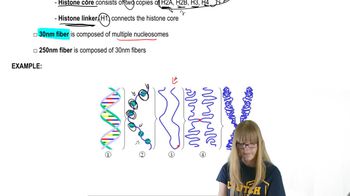
Chromosomes are composed of DNA and proteins, with a central region called the centromere that divides the chromosome into two arms. The centromere's position influences the shape and classification of the chromosome.
Recommended video:
Guided course
Chromosome Structure
Centromere Placement Types
Chromosomes are classified based on centromere location into metacentric (centromere in the middle), submetacentric (off-center), acrocentric (near one end), and telocentric (at the end). This classification helps in identifying and comparing chromosomes.
Recommended video:
Guided course
Types of Maternal Inheritance
Karyotyping and Chromosome Naming
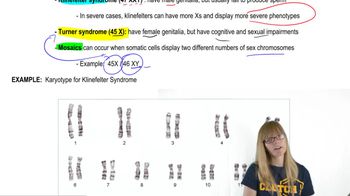
Karyotyping is the process of pairing and ordering chromosomes by size and centromere position. Chromosomes are named and numbered based on these features, aiding genetic analysis and diagnosis of chromosomal abnormalities.
Recommended video:
Guided course
Human Sex Chromosomes
Related Videos
Related Practice
Textbook Question
725
views