How are chromosomes named on the basis of their centromere placement?
Table of contents
- 1. Introduction to Genetics51m
- 2. Mendel's Laws of Inheritance3h 37m
- 3. Extensions to Mendelian Inheritance2h 41m
- 4. Genetic Mapping and Linkage2h 28m
- 5. Genetics of Bacteria and Viruses1h 21m
- 6. Chromosomal Variation1h 48m
- 7. DNA and Chromosome Structure56m
- 8. DNA Replication1h 10m
- 9. Mitosis and Meiosis1h 34m
- 10. Transcription1h 0m
- 11. Translation58m
- 12. Gene Regulation in Prokaryotes1h 19m
- 13. Gene Regulation in Eukaryotes44m
- 14. Genetic Control of Development44m
- 15. Genomes and Genomics1h 50m
- 16. Transposable Elements47m
- 17. Mutation, Repair, and Recombination1h 6m
- 18. Molecular Genetic Tools19m
- 19. Cancer Genetics29m
- 20. Quantitative Genetics1h 26m
- 21. Population Genetics50m
- 22. Evolutionary Genetics29m
9. Mitosis and Meiosis
Mitosis
Problem 11d
Textbook Question
Describe the role of the following structures or proteins in cell division:
Synaptonemal complex
Verified step by step guidance1
The synaptonemal complex is a protein structure that forms between homologous chromosomes during prophase I of meiosis. It plays a critical role in ensuring proper chromosome pairing and alignment.
This structure facilitates the process of synapsis, where homologous chromosomes come together and align tightly along their lengths.
The synaptonemal complex stabilizes the homologous chromosomes, allowing for the exchange of genetic material through crossing over, which occurs at specific points called chiasmata.
Crossing over, mediated by the synaptonemal complex, increases genetic diversity by shuffling alleles between homologous chromosomes.
Once crossing over is complete, the synaptonemal complex disassembles, allowing the homologous chromosomes to separate and proceed to the next stages of meiosis.
Verified video answer for a similar problem:This video solution was recommended by our tutors as helpful for the problem above
Video duration:
1mPlay a video:
Was this helpful?
Key Concepts
Here are the essential concepts you must grasp in order to answer the question correctly.
Synaptonemal Complex
The synaptonemal complex is a protein structure that forms between homologous chromosomes during meiosis. It facilitates the pairing and alignment of homologs, ensuring accurate segregation during cell division. This complex is crucial for genetic recombination, as it allows for the exchange of genetic material between homologous chromosomes, contributing to genetic diversity.
Recommended video:
Guided course
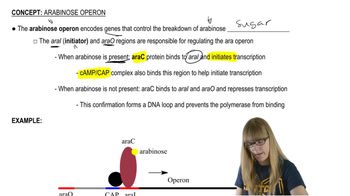
Arabinose Operon
Meiosis
Meiosis is a specialized type of cell division that reduces the chromosome number by half, resulting in four haploid cells from one diploid cell. It consists of two sequential divisions: meiosis I and meiosis II. This process is essential for sexual reproduction, as it produces gametes (sperm and eggs) that carry half the genetic information necessary for the formation of a new organism.
Recommended video:
Guided course
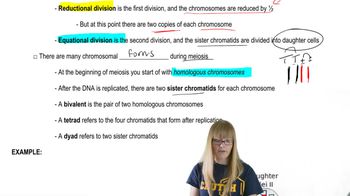
Meiosis Overview
Homologous Chromosomes
Homologous chromosomes are pairs of chromosomes, one inherited from each parent, that have the same genes at the same loci but may carry different alleles. During meiosis, these chromosomes undergo pairing and recombination, which is facilitated by the synaptonemal complex. This pairing is vital for ensuring that each gamete receives one chromosome from each homologous pair, maintaining genetic stability across generations.
Recommended video:
Guided course
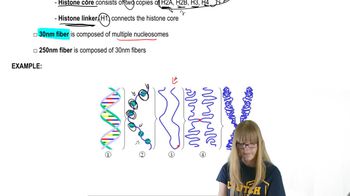
Chromosome Structure
Related Videos
Related Practice
Textbook Question
863
views