You have sequenced a 100-kb region of the Bacillus anthracis genome (the bacterium that causes anthrax) and a 100-kb region from the Gorilla gorilla genome. What differences and similarities might you expect to see in the annotation of the sequences, for example, in the number of genes, gene structure, regulatory sequences, and repetitive DNA?
Table of contents
- 1. Introduction to Genetics51m
- 2. Mendel's Laws of Inheritance3h 37m
- 3. Extensions to Mendelian Inheritance2h 41m
- 4. Genetic Mapping and Linkage2h 28m
- 5. Genetics of Bacteria and Viruses1h 21m
- 6. Chromosomal Variation1h 48m
- 7. DNA and Chromosome Structure56m
- 8. DNA Replication1h 10m
- 9. Mitosis and Meiosis1h 34m
- 10. Transcription1h 0m
- 11. Translation58m
- 12. Gene Regulation in Prokaryotes1h 19m
- 13. Gene Regulation in Eukaryotes44m
- 14. Genetic Control of Development44m
- 15. Genomes and Genomics1h 50m
- 16. Transposable Elements47m
- 17. Mutation, Repair, and Recombination1h 6m
- 18. Molecular Genetic Tools19m
- 19. Cancer Genetics29m
- 20. Quantitative Genetics1h 26m
- 21. Population Genetics50m
- 22. Evolutionary Genetics29m
15. Genomes and Genomics
Sequencing the Genome
Problem 25b
Textbook Question
Whole-exome sequencing (WES) is helping physicians diagnose a genetic condition that has defied diagnosis by traditional means. The implication here is that exons in the nuclear genome are sequenced in the hopes that, by comparison with the genomes of nonaffected individuals, a diagnosis might be revealed.
If you were ordering WES for a patient, would you also include an analysis of the patient's mitochondrial genome?
Verified step by step guidance1
Understand that Whole-exome sequencing (WES) targets the exons of nuclear DNA, which are the protein-coding regions of the nuclear genome.
Recognize that the mitochondrial genome is separate from the nuclear genome and consists of a small circular DNA molecule found in mitochondria, which is not covered by standard WES.
Consider that many genetic conditions can be caused by mutations in mitochondrial DNA, which would not be detected by WES alone.
Therefore, if a mitochondrial disorder is suspected or if the clinical presentation suggests mitochondrial involvement, it is important to order a separate analysis specifically targeting the mitochondrial genome.
In summary, WES does not include mitochondrial DNA analysis, so to comprehensively evaluate genetic causes, especially those related to mitochondria, a dedicated mitochondrial genome analysis should be included.
Verified video answer for a similar problem:This video solution was recommended by our tutors as helpful for the problem above
Video duration:
39sPlay a video:
Was this helpful?
Key Concepts
Here are the essential concepts you must grasp in order to answer the question correctly.
Whole-Exome Sequencing (WES)
WES is a genomic technique that sequences all the protein-coding regions (exons) of nuclear DNA. Since exons represent about 1-2% of the genome but harbor most known disease-causing mutations, WES is efficient for identifying genetic variants linked to disorders. It focuses on nuclear DNA and typically excludes non-coding regions and mitochondrial DNA.
Recommended video:
Guided course
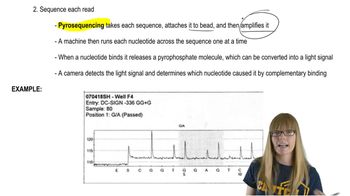
Sequencing Overview
Mitochondrial Genome and Its Role in Disease
The mitochondrial genome is a small, circular DNA molecule found in mitochondria, inherited maternally and separate from nuclear DNA. Mutations in mitochondrial DNA can cause distinct genetic disorders, often affecting energy metabolism. Because WES targets nuclear exons, mitochondrial DNA is usually not analyzed unless specifically requested.
Recommended video:
Guided course
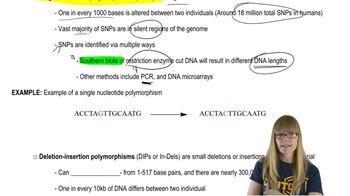
Genomic Variation
Diagnostic Strategy for Genetic Disorders
Choosing which genomic regions to analyze depends on the suspected disease and inheritance pattern. For unexplained conditions, including mitochondrial genome analysis alongside WES can be crucial if mitochondrial disease is suspected. Comprehensive diagnosis may require combining nuclear and mitochondrial DNA sequencing to capture all possible genetic causes.
Recommended video:
Guided course
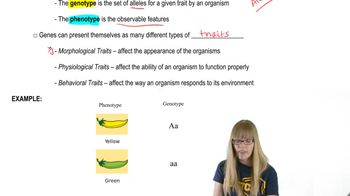
Descriptive Genetics
Related Videos
Related Practice
Textbook Question
358
views
