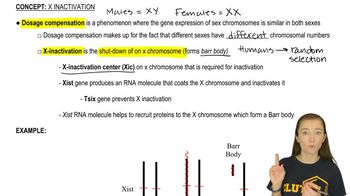
The gene causing Coffin–Lowry syndrome (OMIM 303600) was recently identified and mapped on the human X chromosome. Coffin–Lowry syndrome is a rare disorder affecting brain morphology and development. It also produces skeletal and growth abnormalities, as well as abnormalities of motor control. Coffin–Lowry syndrome affects males who inherit a mutation of the X-linked gene. Most carrier females show no symptoms of the disease but a few carriers do. These carrier females are always less severely affected than males. Offer an explanation for this finding.
Table of contents
- 1. Introduction to Genetics51m
- 2. Mendel's Laws of Inheritance3h 37m
- 3. Extensions to Mendelian Inheritance2h 41m
- 4. Genetic Mapping and Linkage2h 28m
- 5. Genetics of Bacteria and Viruses1h 21m
- 6. Chromosomal Variation1h 48m
- 7. DNA and Chromosome Structure56m
- 8. DNA Replication1h 10m
- 9. Mitosis and Meiosis1h 34m
- 10. Transcription1h 0m
- 11. Translation58m
- 12. Gene Regulation in Prokaryotes1h 19m
- 13. Gene Regulation in Eukaryotes44m
- 14. Genetic Control of Development44m
- 15. Genomes and Genomics1h 50m
- 16. Transposable Elements47m
- 17. Mutation, Repair, and Recombination1h 6m
- 18. Molecular Genetic Tools19m
- 19. Cancer Genetics29m
- 20. Quantitative Genetics1h 26m
- 21. Population Genetics50m
- 22. Evolutionary Genetics29m
2. Mendel's Laws of Inheritance
Sex-Linked Genes
Problem 22
Textbook Question
The genes encoding the red- and green-color-detecting proteins of the human eye are located next to one another on the X chromosome and probably evolved from a common ancestral pigment gene. The two proteins demonstrate 76 percent homology in their amino acid sequences. A normal-visioned woman (with both genes present on each of her two X chromosomes) has a red-color-blind son who was shown to have one copy of the green-detecting gene and no copies of the red-detecting gene. Devise an explanation for these observations at the chromosomal level (involving meiosis).
Verified step by step guidance1
Step 1: Understand the genetic context. The red- and green-color-detecting genes are located close together on the X chromosome, which means they are linked genes. Since males have only one X chromosome, they inherit their X chromosome from their mother and a Y chromosome from their father.
Step 2: Consider the mother's genotype. She has two X chromosomes, each carrying both the red- and green-detecting genes. This means she is likely heterozygous or homozygous for these genes, with normal vision because both genes are present on each X chromosome.
Step 3: Analyze meiosis in the mother. During meiosis, homologous chromosomes undergo recombination (crossing over), which can exchange segments between the red- and green-detecting gene loci. This can produce recombinant X chromosomes with altered gene combinations.
Step 4: Explain the son's genotype. The son inherited one X chromosome from his mother that contains the green-detecting gene but lacks the red-detecting gene. This suggests that a deletion or unequal crossing over occurred during meiosis, removing the red-detecting gene from that X chromosome.
Step 5: Summarize the chromosomal explanation. The son's red-color blindness results from inheriting an X chromosome missing the red-detecting gene due to a recombination event or deletion during maternal meiosis, while retaining the green-detecting gene. This explains the presence of one green gene and absence of the red gene on his single X chromosome.
Verified video answer for a similar problem:This video solution was recommended by our tutors as helpful for the problem above
Video duration:
1mPlay a video:
Was this helpful?
Key Concepts
Here are the essential concepts you must grasp in order to answer the question correctly.
X-linked Inheritance
X-linked inheritance refers to genes located on the X chromosome, which affect males and females differently due to their sex chromosome composition. Males have one X and one Y chromosome, so a single defective gene on the X chromosome can cause a trait or disorder, like red-green color blindness, to be expressed. Females have two X chromosomes, so they can be carriers without showing symptoms if only one X carries the mutation.
Recommended video:
Guided course
X-Inactivation
Meiosis and Chromosomal Segregation
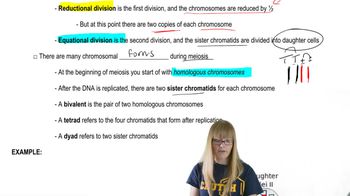
Meiosis is the process of cell division that produces gametes with half the chromosome number. During meiosis, homologous chromosomes pair and can exchange segments through crossing over. This recombination can lead to deletions or duplications of genes, explaining how a son might inherit a missing red-detecting gene if a crossover event deleted it on the X chromosome inherited from his mother.
Recommended video:
Guided course
Meiosis Overview
Gene Duplication and Homology
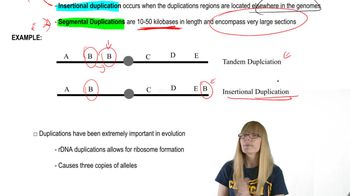
Gene duplication occurs when a gene is copied in the genome, often leading to gene families with similar sequences and functions. The red- and green-detecting pigment genes are paralogs, sharing 76% amino acid sequence homology, indicating they evolved from a common ancestral gene. Their close proximity on the X chromosome makes them susceptible to unequal crossing over, which can cause gene loss or rearrangement.
Recommended video:
Guided course
Duplications
Related Videos
Related Practice
Textbook Question
685
views