Contrast positive versus negative control of gene expression.
Table of contents
- 1. Introduction to Genetics51m
- 2. Mendel's Laws of Inheritance3h 37m
- 3. Extensions to Mendelian Inheritance2h 41m
- 4. Genetic Mapping and Linkage2h 28m
- 5. Genetics of Bacteria and Viruses1h 21m
- 6. Chromosomal Variation1h 48m
- 7. DNA and Chromosome Structure56m
- 8. DNA Replication1h 10m
- 9. Mitosis and Meiosis1h 34m
- 10. Transcription1h 0m
- 11. Translation58m
- 12. Gene Regulation in Prokaryotes1h 19m
- 13. Gene Regulation in Eukaryotes44m
- 14. Genetic Control of Development44m
- 15. Genomes and Genomics1h 50m
- 16. Transposable Elements47m
- 17. Mutation, Repair, and Recombination1h 6m
- 18. Molecular Genetic Tools19m
- 19. Cancer Genetics29m
- 20. Quantitative Genetics1h 26m
- 21. Population Genetics50m
- 22. Evolutionary Genetics29m
12. Gene Regulation in Prokaryotes
Lac Operon
Problem 6
Textbook Question
For the genotypes and conditions (lactose present or absent) shown in the following table, predict whether functional enzymes, nonfunctional enzymes, or no enzymes are made.
<IMAGE>
Verified step by step guidance1
Identify the genes involved in the genotypes provided, typically the lac operon genes such as lacZ, lacY, and lacI, and understand their roles in enzyme production.
Determine the effect of each genotype on the production of enzymes. For example, a functional lacZ gene produces β-galactosidase, while a mutation might produce a nonfunctional enzyme or no enzyme at all.
Consider the presence or absence of lactose, which acts as an inducer by binding to the lac repressor (encoded by lacI) and allowing transcription of the operon. When lactose is absent, the repressor binds to the operator and blocks enzyme production.
For each genotype and condition (lactose present or absent), analyze whether the operon is induced or repressed, and whether the gene products are functional or nonfunctional based on the mutations.
Summarize the results by predicting for each case if functional enzymes, nonfunctional enzymes, or no enzymes are produced, based on the interaction between genotype and lactose presence.
Verified video answer for a similar problem:This video solution was recommended by our tutors as helpful for the problem above
Video duration:
5mPlay a video:
Was this helpful?
Key Concepts
Here are the essential concepts you must grasp in order to answer the question correctly.
Gene Expression Regulation
Gene expression regulation involves controlling when and how genes are turned on or off in response to environmental signals, such as the presence or absence of lactose. This determines whether enzymes are produced and if they are functional, based on the activation or repression of specific genes.
Recommended video:
Guided course
Penetrance and Expressivity
Genotype and Phenotype Relationship
The genotype refers to the genetic makeup of an organism, which influences the phenotype, or observable traits like enzyme functionality. Different genotypes can lead to production of functional enzymes, nonfunctional enzymes, or no enzymes, depending on mutations or gene variants.
Recommended video:
Guided course
Gamete Genotypes
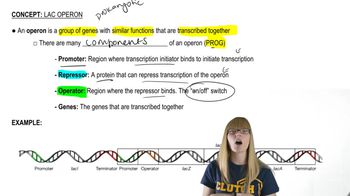
Lactose Operon Model
The lactose operon is a classic example of gene regulation in bacteria, where the presence of lactose induces the production of enzymes needed to metabolize it. Understanding how the operon responds to lactose presence or absence helps predict enzyme production based on genotype.
Recommended video:
Guided course
Lac Operon Overview
Related Videos
Related Practice
Textbook Question
1443
views