For the lac genotypes shown in the following table, predict whether the structural genes (Z) are constitutive, permanently repressed, or inducible in the presence of lactose. Genotype Constitutive Repressed Inducible I⁺O⁺Z⁺ x I⁻O⁺Z⁺ I⁻OᶜZ⁺ I⁻OᶜZ⁺/F'O⁺ I⁺OᶜZ⁺/F'O⁺ IˢO⁺Z⁺ IˢO⁺Z⁺/F'I⁺
Verified step by step guidance
1
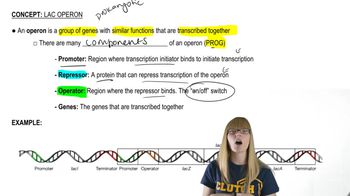
Step 1: Understand the components of the lac operon genotype notation: 'I' refers to the repressor gene, 'O' is the operator site, and 'Z' is the structural gene encoding β-galactosidase. Superscripts indicate the allele type: '+' is wild type, '⁻' is a loss-of-function mutation, 'ᶜ' is a constitutive operator mutation, and 'ˢ' is a super-repressor mutation. F' indicates a plasmid-borne gene.
Step 2: Recall the functional effects of each mutation: I⁺ produces a functional repressor that binds the operator; I⁻ produces no repressor; Iˢ produces a repressor that cannot be inactivated by lactose; O⁺ is a normal operator; Oᶜ is a mutated operator that cannot bind repressor; Z⁺ is a functional structural gene.
Step 3: For each genotype, determine whether the repressor can bind the operator and whether lactose can induce the operon. For example, if the repressor is absent (I⁻), the operon is constitutive; if the operator is mutated (Oᶜ), the repressor cannot bind, leading to constitutive expression; if the repressor is super-repressor (Iˢ), the operon is permanently repressed.
Step 4: Consider the presence of F' plasmids carrying different operator or repressor alleles. Since the lac operon is cis-regulated by the operator, mutations in the operator on the chromosome affect only the chromosome's operon, while repressor mutations on F' plasmids can act in trans and affect both operons.
Step 5: Using these principles, classify each genotype as constitutive, permanently repressed, or inducible by analyzing the interaction between the repressor and operator alleles, and the presence or absence of functional lactose induction.
Verified video answer for a similar problem:
This video solution was recommended by our tutors as helpful for the problem above
Video duration:
3m
Play a video:
Was this helpful?
Key Concepts
Here are the essential concepts you must grasp in order to answer the question correctly.
Lac Operon Structure and Function
The lac operon in E. coli includes structural genes (like lacZ) and regulatory elements (promoter, operator, and repressor gene lacI). It controls lactose metabolism by turning gene expression on or off depending on lactose presence, enabling bacteria to conserve energy by producing enzymes only when needed.
Role of the Repressor Protein (lacI) and Operator (O) Mutations
The lacI gene encodes the repressor protein that binds the operator (O) to block transcription. Mutations in lacI (I⁻, Iˢ) or operator (Oᶜ) affect repressor binding: I⁻ produces no repressor (leading to constitutive expression), Iˢ produces a super-repressor that never releases, and Oᶜ prevents repressor binding, causing constitutive expression.
Inducibility and Constitutive Expression in the Presence of Lactose
In normal cells, lactose acts as an inducer by binding the repressor, causing it to release the operator and allowing transcription (inducible). Constitutive mutants express lac genes regardless of lactose, while permanently repressed mutants never express them. Understanding these states helps predict gene expression patterns from genotypes.