Which of the following repair pathways repairs damage that causes distortions in the double helix?
Table of contents
- 1. Introduction to Genetics51m
- 2. Mendel's Laws of Inheritance3h 37m
- 3. Extensions to Mendelian Inheritance2h 41m
- 4. Genetic Mapping and Linkage2h 28m
- 5. Genetics of Bacteria and Viruses1h 21m
- 6. Chromosomal Variation1h 48m
- 7. DNA and Chromosome Structure56m
- 8. DNA Replication1h 10m
- 9. Mitosis and Meiosis1h 34m
- 10. Transcription1h 0m
- 11. Translation58m
- 12. Gene Regulation in Prokaryotes1h 19m
- 13. Gene Regulation in Eukaryotes44m
- 14. Genetic Control of Development44m
- 15. Genomes and Genomics1h 50m
- 16. Transposable Elements47m
- 17. Mutation, Repair, and Recombination1h 6m
- 18. Molecular Genetic Tools19m
- 19. Cancer Genetics29m
- 20. Quantitative Genetics1h 26m
- 21. Population Genetics50m
- 22. Evolutionary Genetics29m
17. Mutation, Repair, and Recombination
DNA Repair
Problem 2
Textbook Question
Write a short essay contrasting how these concepts may differ between bacteria and eukaryotes.
Verified step by step guidance1
Begin by defining the key concepts you want to contrast between bacteria and eukaryotes, such as gene structure, gene expression, and genetic regulation.
Explain that bacterial genes are often organized in operons, which are clusters of genes transcribed together as a single mRNA, whereas eukaryotic genes are typically monocistronic, meaning one gene per mRNA transcript.
Discuss differences in gene structure: bacterial genes usually lack introns and have simpler promoters, while eukaryotic genes contain introns and exons and have complex promoter and enhancer regions.
Describe how transcription and translation are coupled in bacteria (occurring simultaneously in the cytoplasm), but are separated in eukaryotes (transcription in the nucleus and translation in the cytoplasm).
Highlight differences in genetic regulation mechanisms, such as the use of operons and sigma factors in bacteria versus chromatin remodeling and multiple transcription factors in eukaryotes.
Verified video answer for a similar problem:This video solution was recommended by our tutors as helpful for the problem above
Video duration:
1mPlay a video:
Was this helpful?
Key Concepts
Here are the essential concepts you must grasp in order to answer the question correctly.
Cellular Organization
Bacteria are prokaryotes, meaning they lack a nucleus and membrane-bound organelles, while eukaryotes have a defined nucleus and complex organelles. This fundamental difference affects how genetic material is stored, accessed, and regulated in each cell type.
Recommended video:
Guided course
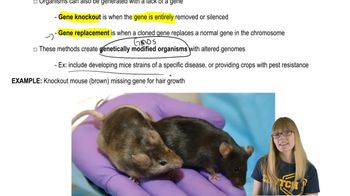
Transgenic Organisms and Gene Therapy
Genetic Material and Replication
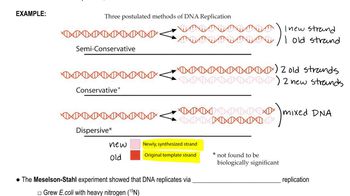
Bacterial DNA is typically a single circular chromosome located in the nucleoid, and replication occurs via binary fission. Eukaryotic DNA is organized into multiple linear chromosomes within the nucleus, and replication involves complex processes including mitosis and meiosis.
Recommended video:
Guided course
Semiconservative Replication
Gene Expression and Regulation
In bacteria, gene expression is often regulated through operons allowing coordinated control of related genes, enabling rapid response to environmental changes. Eukaryotic gene expression is more complex, involving chromatin remodeling, transcription factors, and RNA processing, allowing precise spatial and temporal control.
Recommended video:
Guided course
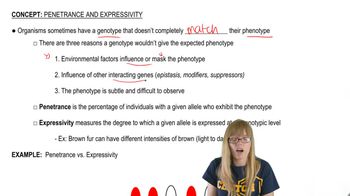
Penetrance and Expressivity
Related Videos
Related Practice
Multiple Choice
670
views
1
rank