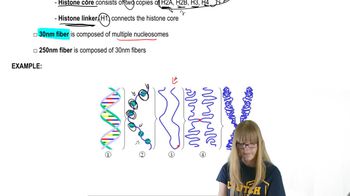
In eukaryotic DNA, along a 6000-bp segment of DNA, approximately how many molecules of each kind of histone protein do you expect to find? Explain your answer.
Table of contents
- 1. Introduction to Genetics51m
- 2. Mendel's Laws of Inheritance3h 37m
- 3. Extensions to Mendelian Inheritance2h 41m
- 4. Genetic Mapping and Linkage2h 28m
- 5. Genetics of Bacteria and Viruses1h 21m
- 6. Chromosomal Variation1h 48m
- 7. DNA and Chromosome Structure56m
- 8. DNA Replication1h 10m
- 9. Mitosis and Meiosis1h 34m
- 10. Transcription1h 0m
- 11. Translation58m
- 12. Gene Regulation in Prokaryotes1h 19m
- 13. Gene Regulation in Eukaryotes44m
- 14. Genetic Control of Development44m
- 15. Genomes and Genomics1h 50m
- 16. Transposable Elements47m
- 17. Mutation, Repair, and Recombination1h 6m
- 18. Molecular Genetic Tools19m
- 19. Cancer Genetics29m
- 20. Quantitative Genetics1h 26m
- 21. Population Genetics50m
- 22. Evolutionary Genetics29m
7. DNA and Chromosome Structure
Eukaryotic Chromosome Structure
Problem 4
Textbook Question
Describe the structure of giant polytene chromosomes and how they arise.
Verified step by step guidance1
Begin by explaining that giant polytene chromosomes are oversized chromosomes commonly found in the salivary glands of certain dipteran insects, such as Drosophila larvae, and are visible under a light microscope due to their large size.
Describe the structure of polytene chromosomes as consisting of many identical chromatids aligned side by side, resulting from repeated rounds of DNA replication without cell division, a process called endoreplication or endomitosis.
Explain that these chromosomes display characteristic banding patterns, with alternating dark and light bands representing regions of tightly packed (heterochromatin) and loosely packed (euchromatin) DNA, respectively.
Discuss how the multiple chromatids remain synapsed (paired) along their length, which allows for the visualization of specific gene loci and chromosomal puffs, where active transcription occurs.
Summarize that giant polytene chromosomes arise through repeated rounds of DNA replication without mitosis, leading to many sister chromatids aligned in parallel, creating their distinctive large, banded appearance.
Verified video answer for a similar problem:This video solution was recommended by our tutors as helpful for the problem above
Video duration:
55sPlay a video:
Was this helpful?
Key Concepts
Here are the essential concepts you must grasp in order to answer the question correctly.
Polytene Chromosome Structure
Polytene chromosomes are oversized chromosomes consisting of many identical chromatids aligned side-by-side, resulting from repeated rounds of DNA replication without cell division. They display characteristic banding patterns visible under a microscope, which correspond to regions of gene activity and chromatin organization.
Recommended video:
Guided course
Chromosome Structure
Endoreplication (Endoreduplication)
Endoreplication is a process where DNA replicates multiple times without subsequent mitosis or cytokinesis, leading to polyploidy within a single nucleus. This mechanism produces the multiple chromatids that form the giant polytene chromosomes, commonly found in certain tissues like salivary glands of Drosophila.
Functional Significance of Polytene Chromosomes
Polytene chromosomes facilitate high levels of gene expression by providing multiple copies of genes in a single nucleus, aiding in rapid protein synthesis. Their distinct banding patterns also allow researchers to study gene activity, chromosomal rearrangements, and developmental regulation.
Recommended video:
Guided course
Functional Genomics
Related Videos
Related Practice
Textbook Question
554
views