Vertex Form of Quadratics Practice 14
Table of contents
- 1. Review of Real Numbers2h 43m
- 2. Linear Equations and Inequalities5h 35m
- 3. Solving Word Problems2h 46m
- 4. Graphs and Functions5h 12m
- The Rectangular Coordinate System44m
- Graph Linear Equations in Two Variables24m
- Graph Linear Equations Using Intercepts23m
- Slope of a Line44m
- Slope-Intercept Form38m
- Point Slope Form22m
- Linear Inequalities in Two Variables28m
- Introduction to Relations and Functions53m
- Function Notation15m
- Composition of Functions17m
- 5. Systems of Linear Equations1h 53m
- 6. Exponents, Polynomials, and Polynomial Functions3h 17m
- 7. Factoring2h 49m
- 8. Rational Expressions and Functions3h 44m
- Simplifying Rational Expressions42m
- Multiplying and Dividing Rational Expressions25m
- Adding and Subtracting Rational Expressions with Common Denominators19m
- Least Common Denominators32m
- Adding and Subtracting Rational Expressions with Different Denominators32m
- Rational Equations44m
- Direct & Inverse Variation27m
- 9. Roots, Radicals, and Complex Numbers2h 33m
- 10. Quadratic Equations and Functions3h 1m
- 11. Inverse, Exponential, & Logarithmic Functions1h 5m
- 12. Conic Sections & Systems of Nonlinear Equations58m
- 13. Sequences, Series, and the Binomial Theorem1h 51m
10. Quadratic Equations and Functions
Graphing Quadratic Equations
Multiple Choice
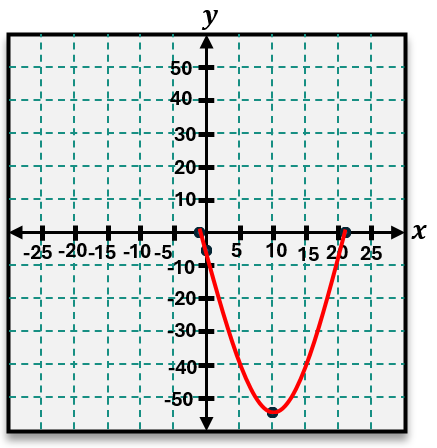
Graph the following quadratics and state its vertex, intercepts and domain & range.
A
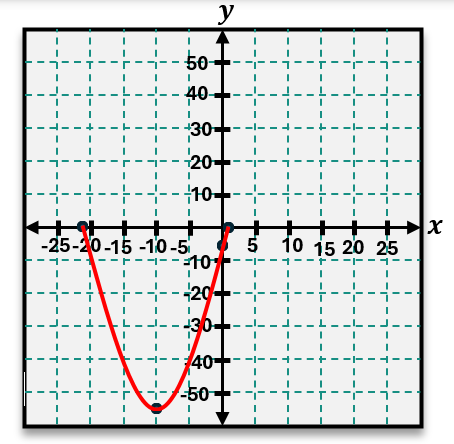
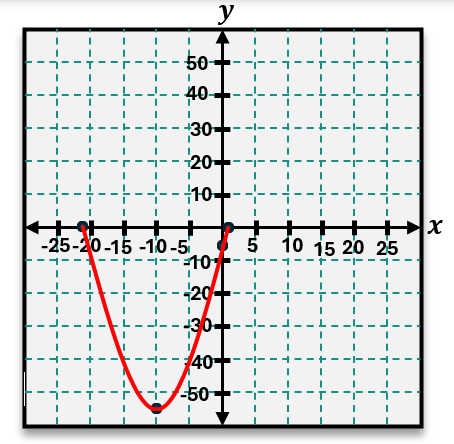
Vertex: (−10,−55); x-intercepts: (0.5,0),(−20.5,0); y-intercept: (0,−5); Domain: (−∞,∞); Range: [−55,∞)
B
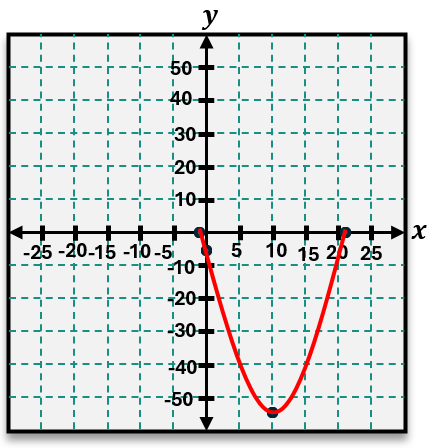
Vertex: (10,55); x-intercepts: (−0.5,0),(20.5,0); y-intercept: (0,−5); Domain: (−∞,∞); Range: [55,∞)
C
Vertex: (−10,−55); x-intercepts: (0.5,0),(−20.5,0); y-intercept: (0,−5); Domain: (−∞,∞); Range: [−55,∞)
D
Vertex: (10,55); x-intercepts: (−0.5,0),(20.5,0); y-intercept: (0,−5); Domain: (−∞,∞); Range: [55,∞)
0 Comments
Verified step by step guidance1
Identify the quadratic function given: \(h(x) = \frac{1}{2}x^2 + 10x - 5\).
Find the vertex using the vertex formula \(x = -\frac{b}{2a}\), where \(a = \frac{1}{2}\) and \(b = 10\). Substitute this \(x\) value back into \(h(x)\) to find the \(y\)-coordinate of the vertex.
Calculate the \(x\)-intercepts by setting \(h(x) = 0\) and solving the quadratic equation \(\frac{1}{2}x^2 + 10x - 5 = 0\) using the quadratic formula \(x = \frac{-b \pm \sqrt{b^2 - 4ac}}{2a}\).
Find the \(y\)-intercept by evaluating \(h(0)\), which is simply the constant term in the quadratic expression.
State the domain and range: The domain of any quadratic function is all real numbers, \((-\infty, \infty)\). The range depends on the vertex; since \(a > 0\), the parabola opens upward, so the range is \([y_{vertex}, \infty)\) where \(y_{vertex}\) is the \(y\)-value of the vertex.
Related Videos
Related Practice
Open Question
1
views