Show that if two plane mirrors meet at an angle Φ, a single ray reflected successively from both mirrors is deflected through an angle of 2Φ independent of the incident angle. Assume Φ < 90° and that only two reflections, one from each mirror, take place.
Verified step by step guidance
1
Start by understanding the geometry of the problem. Two plane mirrors meet at an angle Φ, and a ray of light is incident on one mirror, reflects off it, and then reflects off the second mirror. The goal is to determine the total deflection of the ray after these two reflections.
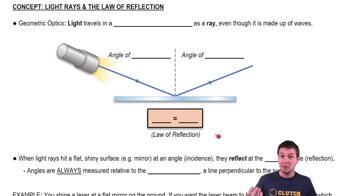
Let the incident ray make an angle θ₁ with the normal to the first mirror. After reflection from the first mirror, the angle of reflection will also be θ₁ (law of reflection: angle of incidence = angle of reflection).
The reflected ray from the first mirror will then strike the second mirror. Let the angle between the reflected ray from the first mirror and the normal to the second mirror be θ₂. Again, by the law of reflection, the angle of reflection from the second mirror will also be θ₂.
Now, consider the geometry of the system. The total deflection of the ray is the angle between the initial incident ray and the final reflected ray. Using the geometry of the two mirrors and the relationships between the angles, it can be shown that the total deflection angle is 2Φ, independent of the initial angle of incidence.
To derive this explicitly, use the fact that the angle between the two mirrors is Φ and apply the law of reflection at each mirror. Carefully analyze the path of the ray and sum the angular changes caused by the two reflections. This will lead to the conclusion that the total deflection is 2Φ.
Verified video answer for a similar problem:
This video solution was recommended by our tutors as helpful for the problem above
Video duration:
6m
Play a video:
Was this helpful?
Key Concepts
Here are the essential concepts you must grasp in order to answer the question correctly.
Reflection of Light
Reflection of light occurs when a light ray strikes a surface and bounces back. The angle of incidence, which is the angle between the incoming ray and the normal (a perpendicular line to the surface), is equal to the angle of reflection. This principle is fundamental in understanding how light behaves when it encounters mirrors.
The angle of deflection refers to the total change in direction of a light ray after it reflects off surfaces. In the case of two mirrors meeting at an angle Φ, the total deflection after two reflections can be calculated as 2Φ. This concept illustrates how the geometry of the mirrors influences the path of the light ray.
Geometric relationships in reflection involve understanding how angles and distances relate to the behavior of light rays. When two mirrors are positioned at an angle, the path of the reflected ray can be analyzed using geometric principles, allowing us to predict the final direction of the ray after multiple reflections, regardless of the initial angle of incidence.