At atmospheric pressure, in what phases can CO₂ exist? Refer to Fig. 18 9 6.
Verified step by step guidance
1
Refer to the phase diagram of CO₂ (Fig. 18.9.6) to understand the relationship between pressure, temperature, and the phases of CO₂. A phase diagram typically shows regions corresponding to solid, liquid, and gas phases, separated by boundary lines.
Identify the atmospheric pressure on the phase diagram. Atmospheric pressure is approximately 1 atm (101.3 kPa). Locate this pressure on the vertical axis of the diagram.
Examine the temperature range at 1 atm pressure. The phase diagram will indicate which phases (solid, liquid, or gas) are present at different temperatures along this pressure line.
Note the triple point of CO₂ on the diagram. The triple point is the unique set of conditions (specific pressure and temperature) where all three phases (solid, liquid, and gas) coexist. For CO₂, the triple point occurs at a pressure higher than 1 atm, meaning liquid CO₂ cannot exist at atmospheric pressure.
Conclude that at atmospheric pressure, CO₂ can only exist in the solid phase (below the sublimation temperature) or the gaseous phase (above the sublimation temperature). Liquid CO₂ is not possible at this pressure.
Verified video answer for a similar problem:
This video solution was recommended by our tutors as helpful for the problem above
Video duration:
2m
Play a video:
Was this helpful?
Key Concepts
Here are the essential concepts you must grasp in order to answer the question correctly.
Phase Diagram
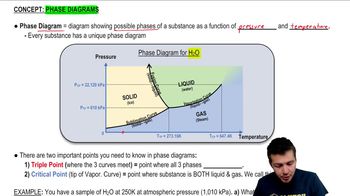
A phase diagram is a graphical representation that shows the different phases of a substance (solid, liquid, gas) at varying temperatures and pressures. It helps to visualize the conditions under which a substance can exist in different states and the transitions between these states, such as melting, boiling, and sublimation.
The triple point of a substance is the specific temperature and pressure at which all three phases (solid, liquid, and gas) coexist in equilibrium. For CO₂, this occurs at a unique set of conditions, and understanding this concept is crucial for determining the phases present at atmospheric pressure.
The critical point is the end point of a phase equilibrium curve, beyond which the distinction between liquid and gas phases disappears. For CO₂, the critical point indicates the highest temperature and pressure at which it can exist as a liquid. Above this point, CO₂ can only exist as a supercritical fluid, which has properties of both gases and liquids.


 2:07 minutes
 Verified step by step guidance
 06:59
06:59