CO₂ exists in what phase when the pressure is 35 atm, and the temperature is 35°C (Fig. 18–6)?
Verified step by step guidance
1
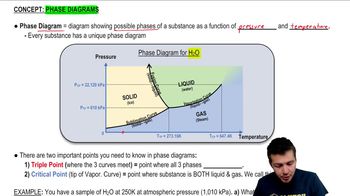
Refer to the phase diagram of CO₂ (Fig. 18–6) to determine the regions corresponding to solid, liquid, and gas phases. A phase diagram shows the state of a substance at various pressures and temperatures.
Locate the given pressure of 35 atm on the vertical axis (pressure axis) of the phase diagram.
Locate the given temperature of 35°C on the horizontal axis (temperature axis) of the phase diagram.
Find the point where the pressure of 35 atm and the temperature of 35°C intersect on the phase diagram. This intersection point will lie in one of the regions (solid, liquid, or gas) or on a boundary line between two phases.
Determine the phase of CO₂ at this intersection point based on the region it falls into. If it lies on a boundary, consider the coexistence of phases as indicated by the diagram.
Verified video answer for a similar problem:
This video solution was recommended by our tutors as helpful for the problem above
Video duration:
2m
Play a video:
0 Comments
Key Concepts
Here are the essential concepts you must grasp in order to answer the question correctly.
Phase of Matter
The phase of matter refers to the distinct forms that different phases of matter take on. The main phases are solid, liquid, and gas, which are determined by temperature and pressure conditions. Understanding how substances transition between these phases is crucial for analyzing their behavior under varying environmental conditions.
A phase diagram is a graphical representation that shows the phases of a substance at different temperatures and pressures. It typically includes lines that separate different phases, indicating the conditions under which a substance exists as a solid, liquid, or gas. Analyzing a phase diagram helps predict the state of a substance based on its specific temperature and pressure.
The critical point is the end point of a phase equilibrium curve, beyond which the distinction between liquid and gas phases disappears. At this point, the substance exhibits properties of both phases, leading to a supercritical fluid state. Understanding the critical point is essential for determining the behavior of substances like CO₂ under high pressure and temperature conditions.


 2:06 minutes
 Verified step by step guidance
 08:59
08:59