Join thousands of students who trust us to help them ace their exams!
Multiple Choice
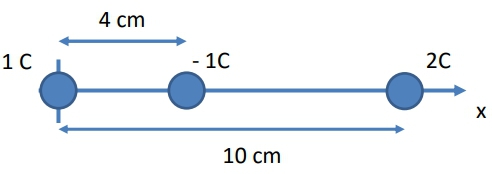
In which direction will the −1 C charge move? If it has a mass of 10 g, what will its initial acceleration be?
A
left; 3.8×10¹⁴ m/s2
B
left; 6.2×10¹³ m/s2
C
left; 6.2×10⁹ m/s2
D
right; 1.1×10¹⁵ m/s2
9 Comments
Verified step by step guidance
1
Identify the forces acting on the -1 C charge due to the other charges. Use Coulomb's Law, which states that the force between two point charges is given by F = k * |q1 * q2| / r^2, where k is Coulomb's constant (8.99 × 10^9 N m^2/C^2), q1 and q2 are the charges, and r is the distance between them.
Calculate the force exerted on the -1 C charge by the 1 C charge. The distance between them is 4 cm (0.04 m). The force will be attractive because the charges are opposite.
Calculate the force exerted on the -1 C charge by the 2 C charge. The distance between them is 10 cm (0.10 m). The force will be repulsive because the charges are opposite.
Determine the net force on the -1 C charge by considering the direction of the forces calculated. The force from the 1 C charge will pull the -1 C charge to the left, while the force from the 2 C charge will push it to the right.
Use Newton's second law, F = m * a, to calculate the initial acceleration of the -1 C charge. Here, m is the mass of the charge (10 g or 0.01 kg), and F is the net force calculated in the previous step. Solve for a to find the acceleration.


 Verified step by step guidance

