
In the atom interferometer experiment of Figure 38.13, laser-cooling techniques were used to cool a dilute vapor of sodium atoms to a temperature of 0.0010 K=1.0 mK. The ultracold atoms passed through a series of collimating apertures to form the atomic beam you see entering the figure from the left. The standing light waves were created from a laser beam with a wavelength of 590 nm. Because interference is observed between the two paths, each individual atom is apparently present at both point B and point C. Describe, in your own words, what this experiment tells you about the nature of matter.
Ch 38: Quantization
Knight Calc5th EditionPhysics for Scientists and EngineersISBN: 9780137344796Not the one you use?Change textbook
Chapter 38, Problem 72c
Consider an electron undergoing cyclotron motion in a magnetic field. According to Bohr, the electron’s angular momentum must be quantized in units of ℏ. Find an expression for the allowed energy levels En in terms of ℏ and the cyclotron frequency fcyc.
Verified step by step guidance1
Start by recalling the quantization condition for angular momentum according to Bohr: \( L = n\hbar \), where \( L \) is the angular momentum, \( n \) is a positive integer (quantum number), and \( \hbar \) is the reduced Planck's constant.
The angular momentum of a particle in circular motion is given by \( L = m_e r v \), where \( m_e \) is the mass of the electron, \( r \) is the radius of the circular motion, and \( v \) is the tangential velocity of the electron.
The centripetal force required for circular motion is provided by the magnetic Lorentz force: \( \frac{m_e v^2}{r} = q_e v B \), where \( q_e \) is the charge of the electron and \( B \) is the magnetic field strength. Solve for \( v \) in terms of \( r \), \( q_e \), \( B \), and \( m_e \).
The cyclotron frequency is defined as \( f_{\text{cyc}} = \frac{q_e B}{2\pi m_e} \). Use this to express the velocity \( v \) in terms of \( f_{\text{cyc}} \) and \( r \). Substitute this expression for \( v \) into the quantization condition \( L = n\hbar \) to find \( r \) in terms of \( n \), \( \hbar \), \( f_{\text{cyc}} \), and \( m_e \).
The total energy of the electron in cyclotron motion is purely kinetic: \( E_n = \frac{1}{2} m_e v^2 \). Use the expressions for \( v \) and \( r \) derived earlier to express \( E_n \) in terms of \( n \), \( \hbar \), and \( f_{\text{cyc}} \). This will give the quantized energy levels \( E_n \).

Verified video answer for a similar problem:
This video solution was recommended by our tutors as helpful for the problem above.
Was this helpful?
Key Concepts
Here are the essential concepts you must grasp in order to answer the question correctly.
Cyclotron Motion
Cyclotron motion refers to the circular motion of a charged particle, such as an electron, in a magnetic field. The magnetic force acts as a centripetal force, causing the particle to move in a circular path. The frequency of this motion, known as the cyclotron frequency, is directly proportional to the strength of the magnetic field and the charge-to-mass ratio of the particle.
Recommended video:
Guided course
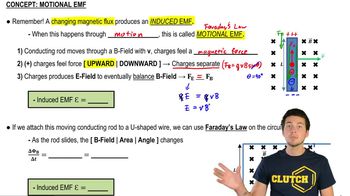
Motional EMF
Quantization of Angular Momentum
In quantum mechanics, the angular momentum of a particle is quantized, meaning it can only take on discrete values. According to Bohr's model, the angular momentum of an electron in an atom is quantized in units of ℏ (h-bar), where ℏ = h/(2π) and h is Planck's constant. This principle is crucial for determining the allowed energy levels of the electron in a magnetic field.
Recommended video:
Guided course
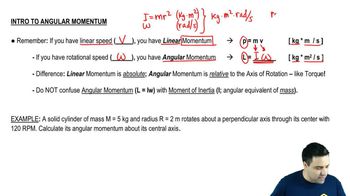
Intro to Angular Momentum
Energy Levels and Cyclotron Frequency
The energy levels of an electron in cyclotron motion can be expressed in terms of the cyclotron frequency (fcyc), which is the frequency at which the electron orbits due to the magnetic field. The allowed energy levels are quantized and can be derived from the relationship between angular momentum and cyclotron frequency, leading to the expression En = nℏfcyc, where n is a quantum number representing the energy level.
Recommended video:
Guided course
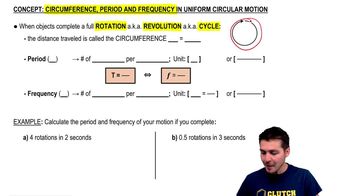
Circumference, Period, and Frequency in UCM
Related Practice
Textbook Question
1442
views
Textbook Question
The electrons in a cathode-ray tube are accelerated through a 250 V potential difference and then shot through a 33-nm-diameter circular aperture. What is the diameter of the bright spot on an electron detector 1.5 m behind the aperture?
78
views
Textbook Question
Consider an electron undergoing cyclotron motion in a magnetic field. According to Bohr, the electron’s angular momentum must be quantized in units of ℏ. Compute the first four allowed radii in a 1.0 T magnetic field.
121
views
