A 50 kg laboratory worker is exposed to 20 mJ of beta radiation. What is the dose equivalent in mrem?
Ch 42: Nuclear Physics
Knight Calc5th EditionPhysics for Scientists and EngineersISBN: 9780137344796Not the one you use?Change textbook
Chapter 42, Problem 40
Particle accelerators fire protons at target nuclei so that investigators can study the nuclear reactions that occur. In one experiment, the proton needs to have 20 MeV of kinetic energy as it impacts a 207Pb nucleus. With what initial kinetic energy (in MeV) must the proton be fired toward the lead target? Assume the nucleus stays at rest. Hint: The proton is not a point particle.
Verified step by step guidance1
Understand the problem: The proton must have 20 MeV of kinetic energy when it impacts the 207Pb nucleus. However, the proton is not a point particle, so we must account for the fact that the proton's charge interacts with the electric field of the lead nucleus. This interaction creates a repulsive electrostatic potential energy that the proton must overcome to reach the nucleus.
Step 1: Calculate the electrostatic potential energy between the proton and the lead nucleus at the point of impact. Use the formula for electrostatic potential energy: , where is Coulomb's constant, and are the charges of the proton and lead nucleus, and is the distance of closest approach (approximately the sum of the radii of the proton and lead nucleus).
Step 2: Determine the total energy required for the proton to reach the lead nucleus. The total energy is the sum of the proton's desired kinetic energy at impact (20 MeV) and the electrostatic potential energy calculated in Step 1. This total energy represents the initial kinetic energy the proton must have when fired.
Step 3: Express the initial kinetic energy of the proton as , where is the desired kinetic energy at impact (20 MeV) and is the electrostatic potential energy. Substitute the values from Step 1 and Step 2 into this equation.
Step 4: Solve for the initial kinetic energy . This value represents the energy the proton must have when fired to overcome the electrostatic repulsion and still retain 20 MeV of kinetic energy upon impact with the lead nucleus.

Verified video answer for a similar problem:
This video solution was recommended by our tutors as helpful for the problem above.
Was this helpful?
Key Concepts
Here are the essential concepts you must grasp in order to answer the question correctly.
Kinetic Energy
Kinetic energy is the energy possessed by an object due to its motion, calculated using the formula KE = 1/2 mv², where m is mass and v is velocity. In particle physics, understanding the kinetic energy of particles, such as protons, is crucial for determining their behavior during collisions with target nuclei. The energy must be sufficient to overcome any potential barriers and initiate nuclear reactions.
Recommended video:
Guided course
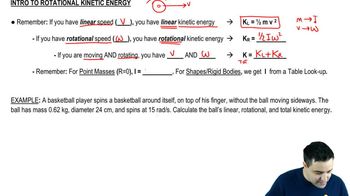
Intro to Rotational Kinetic Energy
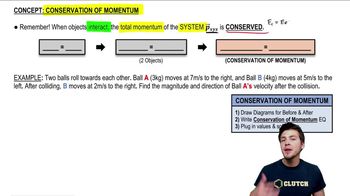
Conservation of Momentum
The conservation of momentum principle states that the total momentum of a closed system remains constant if no external forces act on it. In the context of particle collisions, this means that the momentum before the collision (proton's momentum) must equal the momentum after the collision (combined momentum of the proton and the lead nucleus). This principle is essential for calculating the necessary initial conditions for the proton to achieve the desired kinetic energy during the interaction.
Recommended video:
Guided course
Conservation Of Momentum
Rest Mass and Relativistic Effects
Rest mass refers to the mass of a particle when it is at rest, and it plays a significant role in relativistic physics, especially at high speeds. As particles approach the speed of light, their effective mass increases, affecting their kinetic energy and momentum. In particle accelerators, understanding how rest mass influences the energy required for protons to collide with nuclei is vital for predicting the outcomes of nuclear reactions.
Recommended video:
Guided course
The Doppler Effect
Related Practice
Textbook Question
57
views
Textbook Question
You learned in Chapter 41 that the binding energy of the electron in a hydrogen atom is 13.6 eV. By how much does the mass decrease when a hydrogen atom is formed from a proton and an electron? Give your answer both in atomic mass units and as a percentage of the mass of the hydrogen atom.
194
views
Textbook Question
The doctors planning a radiation therapy treatment have determined that a 100 g tumor needs to receive 0.20 J of gamma radiation. What is the dose in grays?
43
views
Textbook Question
What is the total energy (in MeV) released in the beta-minus decay of ³H?
67
views
Textbook Question
What energy (in MeV) alpha particle has a de Broglie wavelength equal to the diameter of a ²³⁸U nucleus?
912
views
Textbook Question
Use the graph of binding energy to estimate the total energy released if three ⁴He nuclei fuse together to form a ¹²C nucleus.
74
views