Ch 23: The Electric Field
Knight Calc - Physics for Scientists and Engineers 5th Edition
Knight Calc5th EditionPhysics for Scientists and EngineersISBN: 9780137344796Not the one you use?Change textbook
Chapter 23, Problem 24

Air 'breaks down' when the electric field strength reaches 3.0×10⁶ N/C, causing a spark. A parallel-plate capacitor is made from two 4.0 cm×4.0 cm electrodes. How many electrons must be transferred from one electrode to the other to create a spark between the electrodes?

Verified step by step guidance
1
Calculate the area of one electrode using the formula for the area of a square: \( A = \text{side}^2 \). Here, the side length is 4.0 cm, so convert it to meters (\( 1 \text{ cm} = 0.01 \text{ m} \)) before squaring.
Determine the maximum charge \( Q \) that the capacitor can hold before the electric field strength reaches the breakdown value. Use the relationship \( E = \frac{Q}{\varepsilon_0 A} \), where \( E \) is the electric field strength, \( \varepsilon_0 \) is the permittivity of free space (\( 8.85 \times 10^{-12} \ \text{C}^2/\text{N} \cdot \text{m}^2 \)), and \( A \) is the area of the plates.
Rearrange the formula \( E = \frac{Q}{\varepsilon_0 A} \) to solve for \( Q \): \( Q = E \cdot \varepsilon_0 \cdot A \). Substitute the given values for \( E \), \( \varepsilon_0 \), and \( A \) to find \( Q \).
Determine the number of electrons \( n \) required to produce the charge \( Q \) using the relationship \( Q = n \cdot e \), where \( e \) is the elementary charge (\( 1.6 \times 10^{-19} \ \text{C} \)). Rearrange to solve for \( n \): \( n = \frac{Q}{e} \).
Substitute the value of \( Q \) from the previous step and the known value of \( e \) into the formula \( n = \frac{Q}{e} \) to calculate the number of electrons required.

Verified video answer for a similar problem:

This video solution was recommended by our tutors as helpful for the problem above.
Was this helpful?

Key Concepts

Here are the essential concepts you must grasp in order to answer the question correctly.

Electric Field Strength

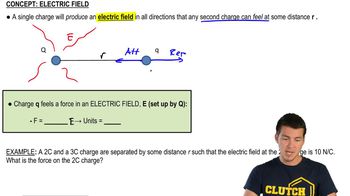
Electric field strength is defined as the force per unit charge experienced by a positive test charge placed in the field. It is measured in newtons per coulomb (N/C) and indicates how strong the electric field is. In this context, the breakdown of air occurs when the electric field strength reaches a critical value, leading to ionization and the formation of a spark.
Recommended video:
Guided course
03:16
Intro to Electric Fields

Capacitance

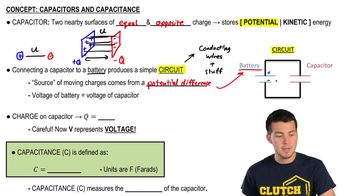
Capacitance is the ability of a system to store electric charge per unit voltage. It is determined by the physical characteristics of the capacitor, such as the area of the plates and the distance between them, and is measured in farads (F). The capacitance of the parallel-plate capacitor in the question can be calculated using the formula C = ε₀(A/d), where ε₀ is the permittivity of free space, A is the area of the plates, and d is the separation distance.
Recommended video:
Guided course
08:02
Capacitors & Capacitance (Intro)

Charge and Electrons

Charge is a fundamental property of matter that causes it to experience a force in an electric field. Electrons carry a negative charge, and the transfer of electrons between the capacitor plates creates an imbalance of charge, leading to the potential difference necessary for a spark. The total charge (Q) can be calculated using the relationship Q = C × V, where V is the voltage across the capacitor, and the number of electrons transferred can be found by dividing the total charge by the elementary charge (approximately 1.6 × 10⁻¹⁹ coulombs).
Recommended video:
Guided course
04:32
Electrons In Water (Using Density)
Related Practice
Textbook Question

FIGURE EX23.25 shows a 1.51.5 g ball hanging from a string inside a parallel-plate capacitor made with 12 cm × 12 cm electrodes. The electrodes are charged to±75 nC. What is the charge on the ball in nC?

2512
views
1
rank

Textbook Question

Two 10-cm-diameter charged rings face each other, 20 cm apart. The left ring is charged to −20 nC and the right ring is charged to +20 nC. What is the force on a proton at the midpoint?

301
views
Textbook Question

Two 10-cm-diameter charged disks face each other, 20 cm apart. The left disk is charged to −50 nC and the right disk is charged to +50 nC. a. What is the electric field Ē, both magnitude and direction, at the midpoint between the two disks?

1491
views
Textbook Question

Two 2.0-cm-diameter disks face each other, 1.0 mm apart. They are charged to ±10 nC. A proton is shot from the negative disk toward the positive disk. What launch speed must the proton have to just barely reach the positive disk?

202
views
Textbook Question

You’ve hung two very large sheets of plastic facing each other with distance d between them, as shown in FIGURE EX23.19. By rubbing them with wool and silk, you’ve managed to give one sheet a uniform surface charge density η1=η0η_1=−η_0 and the other a uniform surface charge density η2=+3η0η_2=+3η_0. What are the electric field vectors at points 1, 2, and 3?

1431
views
Textbook Question

INT The surface charge density on an infinite charged plane is −2.0×10⁻⁶ C/m2. A proton is shot straight away from the plane at 2.0×10⁶ m/s. How far does the proton travel before reaching its turning point?

2301
views