

Ch 23: The Electric Field
Knight Calc - Physics for Scientists and Engineers 5th Edition
Knight Calc5th EditionPhysics for Scientists and EngineersISBN: 9780137344796Not the one you use?Change textbook
Chapter 23, Problem 55a

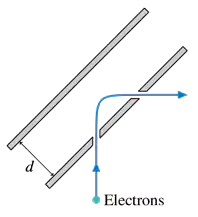
A problem of practical interest is to make a beam of electrons turn a 90° corner. This can be done with the parallel-plate capacitor shown in FIGURE P23.55. An electron with kinetic energy 3.0×10⁻¹⁷ J enters through a small hole in the bottom plate of the capacitor. Should the bottom plate be charged positive or negative relative to the top plate if you want the electron to turn to the right? Explain.
Diagram of a parallel-plate capacitor showing electrons turning 90° as they move through the electric field.

Verified step by step guidance
1
Understand the problem: The goal is to determine the polarity of the plates in a parallel-plate capacitor to make an electron turn to the right. Electrons are negatively charged, so they experience a force in the direction opposite to the electric field.
Recall the relationship between electric field and force: The electric field ( E ) between the plates exerts a force ( F ) on the electron, given by F = q E , where q is the charge of the electron. Since the electron is negatively charged, the force will be in the direction opposite to the electric field.
Determine the direction of the electric field: The electric field inside a parallel-plate capacitor points from the positive plate to the negative plate. To make the electron turn to the right, the force on the electron must point to the right. Therefore, the electric field must point to the left.
Assign the polarity of the plates: To create an electric field pointing to the left, the bottom plate must be positively charged, and the top plate must be negatively charged. This ensures that the electron experiences a force to the right, causing it to turn in the desired direction.
Summarize the reasoning: The bottom plate should be charged positive relative to the top plate to create an electric field pointing to the left. This will exert a force on the negatively charged electron to the right, making it turn the desired 90° corner.

Verified video answer for a similar problem:

This video solution was recommended by our tutors as helpful for the problem above.
Was this helpful?

Key Concepts

Here are the essential concepts you must grasp in order to answer the question correctly.

Electric Field

An electric field is a region around charged particles where other charged particles experience a force. The direction of the electric field is defined as the direction a positive charge would move. In this scenario, the electric field between the plates of the capacitor will determine the force acting on the electron, influencing its trajectory as it moves through the field.
Recommended video:
Guided course
03:16
Intro to Electric Fields

Charge of the Electron

Electrons carry a negative charge, which means they are attracted to positive charges and repelled by negative charges. Understanding the charge of the electron is crucial for predicting its motion in an electric field. In this problem, the interaction between the electron and the charged plates will dictate how the electron will turn as it passes through the capacitor.
Recommended video:
Guided course
04:32
Electrons In Water (Using Density)

Kinetic Energy and Motion

Kinetic energy is the energy an object possesses due to its motion, which is relevant when considering how fast the electron is moving as it enters the capacitor. The kinetic energy of the electron influences its ability to overcome forces acting on it, such as those from the electric field. In this case, the electron's kinetic energy will determine how effectively it can turn when subjected to the electric field created by the charged plates.
Recommended video:
Guided course
06:07
Intro to Rotational Kinetic Energy
Related Practice
Textbook Question

The two parallel plates in FIGURE P23.53 are 2.0 cm apart and the electric field strength between them is 1.0×10⁴ N/C. An electron is launched at a 45° angle from the positive plate. What is the maximum initial speed v0 the electron can have without hitting the negative plate?

243
views
Textbook Question

CALC A uniform electric field’s strength is increasing with time as E=(1.5×10⁴+(5.0×10¹⁰s1)t)N/CE = (1.5 \(\times\) 10^4 + (5.0 \(\times\) 10^{10}\,\(\text{s}\)^{-1})t)\,\(\text{N/C}\). A proton is released in the field from rest at t = 0. What is the proton’s speed 1.0 μs later?

1113
views
Textbook Question

INT In a classical model of the hydrogen atom, the electron orbits the proton in a circular orbit of radius 0.053 nm. What is the orbital frequency in rev/s? The proton is so much more massive than the electron that you can assume the proton is at rest.

1958
views
Textbook Question

An infinite plane of charge with surface charge density 3.2 μC/m2 has a 20-cm-diameter circular hole cut out of it. What is the electric field strength directly over the center of the hole at a distance of 12 cm? Hint: Can you create this charge distribution as a superposition of charge distributions for which you know the electric field?

33
views
Textbook Question

A rod of length LL lies along the yy-axis with its center at the origin. The rod has a nonuniform linear charge density λ=ay λ=a|y|, where a is a constant with the units C/m2. Draw a graph of λλ versus yy over the length of the rod.

363
views
Textbook Question

An electric field can induce an electric dipole in a neutral atom or molecule by pushing the positive and negative charges in opposite directions. The dipole moment of an induced dipole is directly proportional to the electric field. That is, p=αE\(\overrightarrow{p}\)=\(\alpha\]\overrightarrow{E}\), where α is called the polarizability of the molecule. A bigger field stretches the molecule farther and causes a larger dipole moment. An ion with charge q is distance r from a molecule with polarizability α. Find an expression for the force E\(\overrightarrow{E}\)ion on dipole.

2209
views