
Ch 03: Motion in Two or Three Dimensions
Young & Freedman Calc - University Physics 14th Edition
Young & Freedman Calc14th EditionUniversity PhysicsISBN: 9780321973610Not the one you use?Change textbook
Chapter 3, Problem 10

A daring 510 N swimmer dives off a cliff with a running horizontal leap, as shown in Fig. E3.10. What must her minimum speed be just as she leaves the top of the cliff so that she will miss the ledge at the bottom, which is 1.75 m wide and 9.00 m below the top of the cliff?
Illustration of a swimmer diving off a cliff, 9.00 m high, with a ledge 1.75 m wide.

Verified step by step guidance
1
Identify the problem as a projectile motion problem where the swimmer dives horizontally off a cliff. The goal is to find the minimum horizontal speed required to clear the ledge.
Use the kinematic equation for vertical motion to determine the time it takes for the swimmer to fall 9.00 m. The equation is: y=12gt2, where y is the vertical distance, g is the acceleration due to gravity (9.81 m/s²), and t is the time.
Solve the equation for t to find the time it takes to fall 9.00 m. Rearrange the equation to: t=2yg.
Use the time calculated to determine the minimum horizontal speed required to clear the ledge. The horizontal distance covered is given by: x=v0t, where x is the horizontal distance (1.75 m) and v0 is the initial horizontal speed.
Rearrange the equation to solve for v0: v0=xt. Substitute the values for x and t to find the minimum speed.

Verified video answer for a similar problem:

This video solution was recommended by our tutors as helpful for the problem above.
Video duration:
7m
Was this helpful?

Key Concepts

Here are the essential concepts you must grasp in order to answer the question correctly.

Projectile Motion

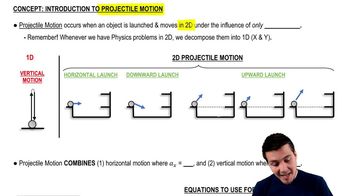
Projectile motion refers to the motion of an object that is launched into the air and is subject to the force of gravity. In this scenario, the swimmer's horizontal leap can be analyzed as a projectile, where the horizontal and vertical motions are independent. The horizontal distance covered and the time taken to fall can be calculated to determine the swimmer's minimum speed.
Recommended video:
Guided course
04:44
Introduction to Projectile Motion

Kinematics Equations

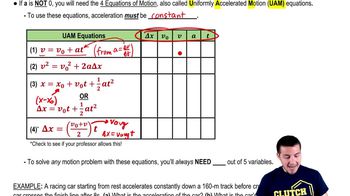
Kinematics equations describe the motion of objects under constant acceleration, such as gravity. For the swimmer, the vertical motion can be analyzed using the equation for free fall, which relates distance, initial velocity, acceleration, and time. This allows us to calculate the time it takes to fall 9.00 m, which is crucial for determining the horizontal speed needed to clear the ledge.
Recommended video:
Guided course
08:25
Kinematics Equations

Horizontal and Vertical Components of Motion

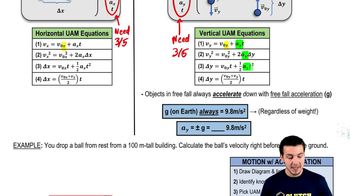
In projectile motion, the horizontal and vertical components of motion are analyzed separately. The horizontal component remains constant (assuming no air resistance), while the vertical component is influenced by gravity. Understanding how to separate these components is essential for calculating the swimmer's minimum horizontal speed to ensure she clears the 1.75 m ledge while falling 9.00 m.
Recommended video:
Guided course
08:36
Vertical Motion & Free Fall
Related Practice
Textbook Question

A remote-controlled car is moving in a vacant parking lot. The velocity of the car as a function of time is given by v=[5.00 m/s(0.0180 m/s3)t2]i^+[2.00 m/s+(0.550 m/s2)t]j^\(\vec{v}\) = \(\left\)[ 5.00~\(\mathrm{m/s}\) - (0.0180~\(\mathrm{m/s^3}\))t^2 \(\right\)] \(\hat{i}\) + \(\left\)[ 2.00~\(\mathrm{m/s}\) + (0.550~\(\mathrm{m/s^2}\))t \(\right\)] \(\hat{j}\). What are the magnitude and direction of the car's velocity at t=8.00 st=8.00\(\text{ }\)s? (b) What are the magnitude and direction of the car's acceleration at t=8.00 st=8.00\(\text{ }\)s?

3510
views
Textbook Question

A rookie quarterback throws a football with an initial upward velocity component of 12.0 m/s and a horizontal velocity component of 20.0 m/s. Ignore air resistance. How high is this point?

3587
views
1
rank
Textbook Question

A remote-controlled car is moving in a vacant parking lot. The velocity of the car as a function of time is given by v=[5.00 m/s(0.0180 m/s3)t2]i^+[2.00 m/s+(0.550 m/s2)t]j^\(\vec{v}\) = \(\left\)[ 5.00~\(\mathrm{m/s}\) - (0.0180~\(\mathrm{m/s^3}\))t^2 \(\right\)] \(\hat{i}\) + \(\left\)[ 2.00~\(\mathrm{m/s}\) + (0.550~\(\mathrm{m/s^2}\))t \(\right\)] \(\hat{j}\). What are ax(t)a_{x}(t) and ay(t)a_{y}(t), the xx- and yy- components of the car's velocity as functions of time?

564
views
Textbook Question

Crickets Chirpy and Milada jump from the top of a vertical cliff. Chirpy drops downward and reaches the ground in 2.70 s, while Milada jumps horizontally with an initial speed of 95.0 cm/s. How far from the base of the cliff will Milada hit the ground? Ignore air resistance.

3876
views
Textbook Question

A physics book slides off a horizontal tabletop with a speed of 1.10 m/s. It strikes the floor in 0.480 s. Ignore air resistance. Find the height of the tabletop above the floor.

5112
views
7
rank
Textbook Question

A rookie quarterback throws a football with an initial upward velocity component of 12.0 m/s and a horizontal velocity component of 20.0 m/s. Ignore air resistance. How much time is required for the football to reach the highest point of the trajectory?

1453
views