Ch 03: Vectors and Coordinate Systems
Knight Calc - Physics for Scientists and Engineers 5th Edition
Knight Calc5th EditionPhysics for Scientists and EngineersISBN: 9780137344796Not the one you use?Change textbook
Chapter 3, Problem 24b

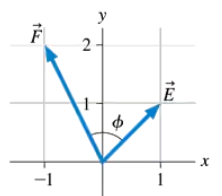
Use geometry and trigonometry to determine the magnitude and direction of G = E+F.

Verified step by step guidance
1
Step 1: Identify the components of the vectors E and F. From the diagram, vector E (green arrow) lies along the x-axis with a magnitude of 3 units, so its components are E_x = 3 and E_y = 0. Vector F (purple arrow) has a magnitude of 2 units and is at an angle θ above the positive x-axis. Its components can be expressed as F_x = 2 * cos(θ) and F_y = 2 * sin(θ).
Step 2: Add the components of the vectors E and F to find the components of vector G. The x-component of G is G_x = E_x + F_x, and the y-component of G is G_y = E_y + F_y. Substitute the values: G_x = 3 + 2 * cos(θ) and G_y = 0 + 2 * sin(θ).
Step 3: Calculate the magnitude of vector G using the Pythagorean theorem. The magnitude |G| is given by |G| = sqrt(G_x^2 + G_y^2). Substitute the expressions for G_x and G_y: |G| = sqrt((3 + 2 * cos(θ))^2 + (2 * sin(θ))^2).
Step 4: Determine the direction of vector G relative to the positive x-axis. The direction φ can be calculated using the formula φ = arctan(G_y / G_x). Substitute the expressions for G_x and G_y: φ = arctan((2 * sin(θ)) / (3 + 2 * cos(θ))).
Step 5: Interpret the results. The magnitude |G| represents the length of the resultant vector, and the angle φ gives its direction relative to the positive x-axis. Ensure that the angle is expressed in degrees or radians as required by the problem.

Verified video answer for a similar problem:

This video solution was recommended by our tutors as helpful for the problem above.
Video duration:
9m
Was this helpful?

Key Concepts

Here are the essential concepts you must grasp in order to answer the question correctly.

Vector Addition

Vector addition involves combining two or more vectors to determine a resultant vector. This is done by adding the corresponding components of the vectors. In a Cartesian coordinate system, the x and y components of each vector are summed separately to find the total vector's magnitude and direction.
Recommended video:
Guided course
07:30
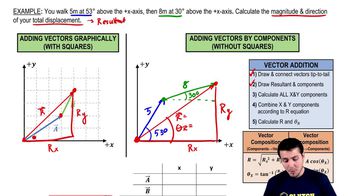
Vector Addition By Components

Trigonometry in Vectors

Trigonometry is essential for analyzing vectors, particularly when determining their components. The sine and cosine functions are used to resolve a vector into its x and y components based on the angle it makes with the axes. This allows for the calculation of the resultant vector's magnitude and direction using geometric relationships.
Recommended video:
Guided course
3:26
Trigonometry

Magnitude and Direction of a Vector

The magnitude of a vector represents its length or size, while the direction indicates the angle it makes with a reference axis. To find the magnitude of the resultant vector, the Pythagorean theorem is often applied, while the direction can be determined using the arctangent function, which relates the opposite and adjacent sides of a right triangle formed by the vector components.
Recommended video:
Guided course
03:59
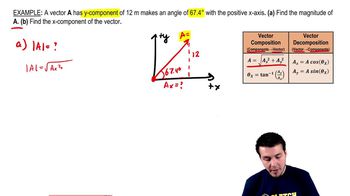
Calculating Magnitude & Components of a Vector