Ch 08: Dynamics II: Motion in a Plane
Knight Calc - Physics for Scientists and Engineers 5th Edition
Knight Calc5th EditionPhysics for Scientists and EngineersISBN: 9780137344796Not the one you use?Change textbook
Chapter 8, Problem 17b

Communications satellites are placed in circular orbits where they stay directly over a fixed point on the equator as the Earth rotates. These are called geosynchronous orbits. The altitude of a geosynchronous orbit is 3.58 x 10⁷ m (approximately 22,00 miles). Astronomical data are inside the back cover of the book. Find the value of g at this altitude.

Verified step by step guidance
1
Step 1: Recall the formula for gravitational acceleration at a distance from the center of the Earth: g=GMr2, where G is the gravitational constant, M is the mass of the Earth, and r is the distance from the center of the Earth.
Step 2: Determine the total distance r from the center of the Earth to the satellite. This is the sum of the Earth's radius (R=6.37×10⁶ m) and the altitude of the geosynchronous orbit (3.58×10⁷ m).
Step 3: Substitute the values of G (6.674×10⁻¹¹ Nm2/kg2), M (5.972×1024 kg), and r (calculated in Step 2) into the formula for g.
Step 4: Perform the necessary calculations to evaluate g. This involves squaring the value of r, multiplying G and M, and dividing by r2.
Step 5: Interpret the result. The value of g at this altitude will be significantly smaller than the gravitational acceleration at the Earth's surface (9.8 m/s2) due to the increased distance from the Earth's center.

Verified video answer for a similar problem:

This video solution was recommended by our tutors as helpful for the problem above.
Video duration:
5m
Was this helpful?

Key Concepts

Here are the essential concepts you must grasp in order to answer the question correctly.

Gravitational Acceleration

Gravitational acceleration, denoted as 'g', is the acceleration experienced by an object due to the gravitational force exerted by a massive body, such as Earth. At the surface of the Earth, this value is approximately 9.81 m/s². However, as altitude increases, 'g' decreases due to the inverse square law of gravitation, which states that gravitational force diminishes with the square of the distance from the center of the mass.
Recommended video:
Guided course
07:32
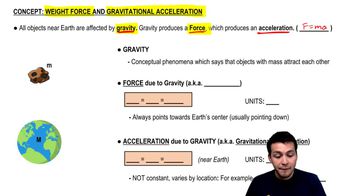
Weight Force & Gravitational Acceleration

Geosynchronous Orbit

A geosynchronous orbit is a circular orbit around the Earth where a satellite's orbital period matches the Earth's rotation period, approximately 24 hours. This allows the satellite to remain fixed over a specific point on the equator. The altitude required for a geosynchronous orbit is about 35,786 kilometers (22,236 miles), where the gravitational pull and the centripetal force balance perfectly.
Recommended video:
Guided course
04:45
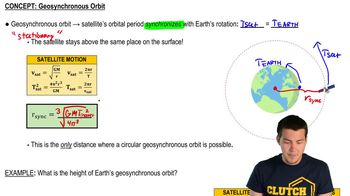
Geosynchronous Orbits

Centripetal Force

Centripetal force is the net force required to keep an object moving in a circular path, directed towards the center of the circle. For satellites in orbit, this force is provided by the gravitational attraction between the satellite and the Earth. The balance between gravitational force and the required centripetal force determines the satellite's stable orbit, which is crucial for maintaining its position relative to the Earth's surface.
Recommended video:
Guided course
06:48
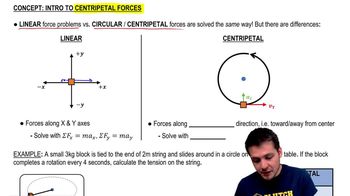
Intro to Centripetal Forces
Related Practice
Textbook Question

A car drives over the top of a hill that has a radius of 50 m. What maximum speed can the car have at the top without flying off the road?

2776
views
1
rank

Textbook Question
Three satellites orbit a planet of radius R, as shown in FIGUREEX13.24. Satellites S₁ and S₃ have mass m. Satellite S₂ has mass 2m. Satellite S₁ orbits in 250 minutes and the force on S₁ is 10,000 N.(b) What are the forces of S₂ and S₃?

2068
views
Textbook Question

Communications satellites are placed in circular orbits where they stay directly over a fixed point on the equator as the Earth rotates. These are called geosynchronous orbits. The altitude of a geosynchronous orbit is 3.58 x 10⁷ m (approximately 22,00 miles). Astronomical data are inside the back cover of the book. What is the weight of a 2000 kg satellite in a geosynchronous orbit?

816
views
Textbook Question

It is proposed that future space stations create an artificial gravity by rotating. Suppose a space station is constructed as a 1000-m-diameter cylinder that rotates about its axis. The inside surface is the deck of the space station. What rotation period will provide 'normal' gravity?

3112
views
Textbook Question

A satellite orbiting the moon very near the surface has a period of 110 min. What is free-fall acceleration on the surface of the moon? Astronomical data are inside the back cover of the book.

3024
views
Textbook Question

The weight of passengers on a roller coaster increases by 50% as the car goes through a dip with a 30 m radius of curvature. What is the car's speed at the bottom of the dip?

2226
views