Ch 15: Mechanical Waves
Young & Freedman Calc - University Physics 14th Edition
Young & Freedman Calc14th EditionUniversity PhysicsISBN: 9780321973610Not the one you use?Change textbook
Chapter 15, Problem 46a

A horizontal string tied at both ends is vibrating in its fundamental mode. The traveling waves have speed vv, frequency ff, amplitude AA, and wavelength λ\(\lambda\). Calculate the maximum transverse velocity and maximum transverse acceleration of points located at (i) x=λ/2x = λ/2, (ii) x=λ/4x = λ/4, and (iii) x=λ/8x = λ/8, from the left-hand end of the string.

Verified step by step guidance
1
Understand the fundamental mode of vibration: In the fundamental mode, the string vibrates with a single antinode in the center and nodes at both ends. The wavelength λ is twice the length of the string.
Identify the wave equation: The displacement y of a point on the string can be described by the equation y(x, t) = A sin(kx) cos(ωt), where k = 2π/λ is the wave number and ω = 2πf is the angular frequency.
Calculate the maximum transverse velocity: The maximum transverse velocity occurs when the derivative of y with respect to time is at its maximum. This is given by v_max = Aω sin(kx). Substitute x = λ/2, λ/4, and λ/8 into this equation to find the maximum transverse velocity at each point.
Calculate the maximum transverse acceleration: The maximum transverse acceleration occurs when the second derivative of y with respect to time is at its maximum. This is given by a_max = Aω² sin(kx). Substitute x = λ/2, λ/4, and λ/8 into this equation to find the maximum transverse acceleration at each point.
Evaluate the sine function at specific points: For x = λ/2, λ/4, and λ/8, calculate sin(kx) using k = 2π/λ. This will help determine the values of maximum transverse velocity and acceleration at these points.

Verified video answer for a similar problem:

This video solution was recommended by our tutors as helpful for the problem above.
Video duration:
17m
Was this helpful?

Key Concepts

Here are the essential concepts you must grasp in order to answer the question correctly.

Wave Motion

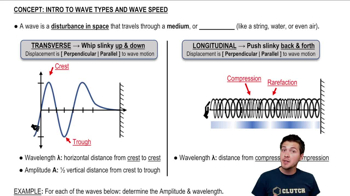
Wave motion refers to the transfer of energy through a medium via oscillations or vibrations. In the context of a vibrating string, waves travel along the string, characterized by parameters such as speed, frequency, amplitude, and wavelength. Understanding wave motion is crucial for analyzing the behavior of points on the string as they oscillate transversely.
Recommended video:
Guided course
07:19
Intro to Waves and Wave Speed

Transverse Velocity

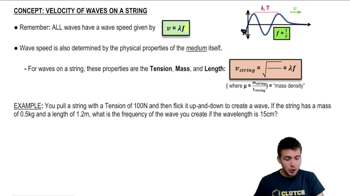
Transverse velocity is the speed at which a point on a vibrating string moves perpendicular to the direction of wave propagation. It is determined by the wave's amplitude and frequency, and reaches its maximum when the point is at the equilibrium position. Calculating transverse velocity helps in understanding the dynamic behavior of the string at specific locations.
Recommended video:
Guided course
03:48
Velocity of Waves on a String

Transverse Acceleration

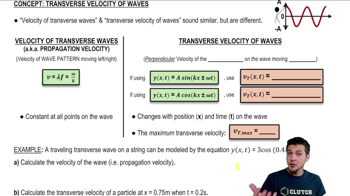
Transverse acceleration is the rate of change of transverse velocity for a point on a vibrating string. It is maximum when the point is at the extreme positions of its oscillation. This concept is essential for determining the forces acting on the string and understanding how the string's motion changes over time at different points.
Recommended video:
Guided course
07:32
Transverse Velocity of Waves
Related Practice
Textbook Question

The wave function of a standing wave is y(x,t)=4.44 mmsin[(32.5 rad/m)x]sin[(754rad/s)t]y(x,t)=4.44\(\text{ mm}\]\sin\)[(32.5\(\text{ rad/m}\))x]\(\sin\)[(754\(\text{rad/s}\))t]. For the two traveling waves that make up this standing wave, find the frequency.

1495
views

Textbook Question

One string of a certain musical instrument is 75.0 cm long and has a mass of 8.75 g. It is being played in a room where the speed of sound is 344 m/s. (a) To what tension must you adjust the string so that, when vibrating in its second overtone, it produces sound of wavelength 0.765 m? (Assume that the break-ing stress of the wire is very large and isn't exceeded.) (b) What frequency sound does this string produce in its fundamental mode of vibration?

2676
views
Textbook Question

A horizontal string tied at both ends is vibrating in its fundamental mode. The traveling waves have speed vv, frequency ff, amplitude AA, and wavelength λ\(\lambda\). How much time does it take the string to go from its largest upward displacement to its largest downward displacement at the points located at (i) x=λ/2x = λ/2, (ii) x=λ/4x = λ/4, and (iii) x=λ/8x = λ/8, from the left-hand end of the string.

1754
views
Textbook Question

A horizontal string tied at both ends is vibrating in its fundamental mode. The traveling waves have speed vv, frequency ff, amplitude AA, and wavelength λ\(\lambda\). What is the amplitude of the motion at the points located at (i) x=λ/2x = λ/2, (ii) x=λ/4x = λ/4, and (iii) x=λ/8x = λ/8, from the left-hand end of the string?

1751
views
Textbook Question

The wave function of a standing wave is y(x,t)=4.44 mmsin[(32.5 rad/m)x]sin[(754rad/s)t]y(x,t)=4.44\(\text{ mm}\]\sin\)[(32.5\(\text{ rad/m}\))x]\(\sin\)[(754\(\text{rad/s}\))t]. For the two traveling waves that make up this standing wave, find the wave speed.

1497
views