
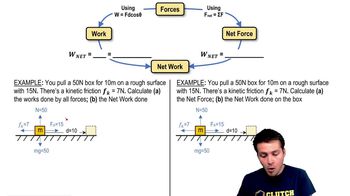
A factory worker pushes a -kg crate a distance of m along a level floor at constant velocity by pushing horizontally on it. The coefficient of kinetic friction between the crate and the floor is . What is the total work done on the crate?
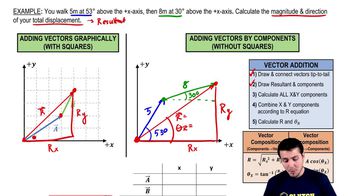
Two tugboats pull a disabled supertanker. Each tug exerts a constant force of N, one west of north and the other east of north, as they pull the tanker km toward the north. What is the total work they do on the supertanker?
Verified step by step guidance
Verified video answer for a similar problem:
Key Concepts
Work
Vector Components
Net Force
A -kg book is sliding along a rough horizontal surface. At point it is moving at m/s, and at point it has slowed to m/s. How much work was done on the book between and ?
You throw a -N rock vertically into the air from ground level. You observe that when it is m above the ground, it is traveling at m/s upward. Use the work–energy theorem to find the rock's speed just as it left the ground.
Is it reasonable that a -kg child could run fast enough to have J of kinetic energy?
A factory worker pushes a -kg crate a distance of m along a level floor at constant velocity by pushing horizontally on it. The coefficient of kinetic friction between the crate and the floor is . How much work is done on the crate by the normal force? By gravity?
A factory worker pushes a -kg crate a distance of m along a level floor at constant velocity by pushing horizontally on it. The coefficient of kinetic friction between the crate and the floor is . How much work is done on the crate by friction?
