

Ch 34: Ray Optics
Knight Calc - Physics for Scientists and Engineers 5th Edition
Knight Calc5th EditionPhysics for Scientists and EngineersISBN: 9780137344796Not the one you use?Change textbook
Chapter 34, Problem 74

Some electro-optic materials can change their index of refraction in response to an applied voltage. Suppose a plano-convex lens (flat on one side, a 15.0 cm radius of curvature on the other), made from a material whose normal index of refraction is 1.500, is creating an image of an object that is 50.0 cm from the lens. By how much would the index of refraction need to be increased to move the image 5.0 cm closer to the lens?

Verified step by step guidance
1
Step 1: Begin by understanding the lens maker's equation, which relates the focal length of a lens to its radius of curvature and index of refraction. The equation is: 1f=(n-1)[1R], where f is the focal length, n is the index of refraction, and R is the radius of curvature.
Step 2: Use the thin lens equation to relate the object distance (do), image distance (di), and focal length (f): 1f=1do+1di. Substitute the given object distance (50.0 cm) and the initial image distance (55.0 cm, since the image is moved 5.0 cm closer). Solve for the initial focal length.
Step 3: Recalculate the focal length after the image is moved 5.0 cm closer to the lens. Use the thin lens equation again, but this time with the new image distance (50.0 cm). This will give the new focal length required to achieve the new image position.
Step 4: Use the lens maker's equation to find the new index of refraction (n) that corresponds to the new focal length. Rearrange the lens maker's equation to solve for n: n=1+fR. Substitute the new focal length and the radius of curvature (15.0 cm).
Step 5: Calculate the change in the index of refraction by subtracting the original index of refraction (1.500) from the new index of refraction obtained in Step 4. This will give the required increase in the index of refraction to move the image 5.0 cm closer to the lens.

Verified video answer for a similar problem:

This video solution was recommended by our tutors as helpful for the problem above.
Was this helpful?

Key Concepts

Here are the essential concepts you must grasp in order to answer the question correctly.

Index of Refraction

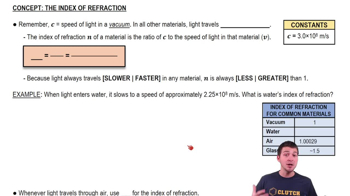
The index of refraction is a dimensionless number that describes how light propagates through a medium. It is defined as the ratio of the speed of light in a vacuum to the speed of light in the medium. A higher index indicates that light travels slower in that medium, which affects how light bends when entering or exiting the material.
Recommended video:
Guided course
03:46
Index of Refraction

Lens Formula

The lens formula relates the object distance (u), image distance (v), and focal length (f) of a lens, expressed as 1/f = 1/v + 1/u. This formula is crucial for determining the position of the image formed by a lens based on the object's position and the lens's characteristics, including its curvature and refractive index.
Recommended video:
05:38
Lens Maker Equation

Electro-Optic Effect

The electro-optic effect refers to the change in the optical properties of a material in response to an applied electric field. In the context of electro-optic materials, this effect can alter the index of refraction, allowing for dynamic control of light propagation, which is essential for applications like modulators and switches in optical systems.
Recommended video:
Guided course
07:40
The Doppler Effect
Related Practice
Textbook Question

The mirror in FIGURE CP34.79 is covered with a piece of glass whose thickness at the center equals the mirror's radius of curvature. A point source of light is outside the glass. How far from the mirror is the image of this source?

1354
views
Textbook Question

A plano-concave glass lens (flat on one side, concave on the other) creates an with magnification +0.40 of an object 75 cm from the lens. What is the radius of curvature of the lens's curved surface?

74
views
Textbook Question

An object is 60 cm from a screen. What are the radii of a symmetric converging plastic lens (i.e., two equally curved surfaces) that will form an image on the screen twice the height of the object?

71
views
Textbook Question

A 2.0-cm-tall object is placed in front of a mirror. A 1.0-cm-tall upright image is formed behind the mirror, 150 cm from the object. What is the focal length of the mirror?

94
views
Textbook Question

CALC A wildlife photographer with a 200-mm-focal-length telephoto lens on his camera is taking a picture of a rhinoceros that is 100 m away. Suddenly, the rhino starts charging straight toward the photographer at a speed of 5.0 m/s. What is the speed, in μm/s, image of the of the rhinoceros? Is the image moving toward or away from the lens?

93
views
Textbook Question

Consider a lens having index of refraction n₂ and surfaces with radii R₁ and R₂. The lens is immersed in a fluid that has index of refraction n₁. A symmetric converging glass lens (i.e., two equally curved surfaces) has two surfaces with radii of 40 cm. Find the focal length of this lens in air and the focal length of this lens in water.

66
views