Ch 18: Thermal Properties of Matter
Young & Freedman Calc - University Physics 14th Edition
Young & Freedman Calc14th EditionUniversity PhysicsISBN: 9780321973610Not the one you use?Change textbook
Chapter 18, Problem 29

We have two equal-size boxes, A and B. Each box contains gas that behaves as an ideal gas. We insert a thermometer into each box and find that the gas in box A is at 5050°C while the gas in box B is at 1010°C. This is all we know about the gas in the boxes. Which of the following statements must be true? Which could be true? Explain your reasoning.
(a) The pressure in A is higher than in B.
(b) There are more molecules in A than in B.
(c) A and B do not contain the same type of gas.
(d) The molecules in A have more average kinetic energy per molecule than those in B.
(e) The molecules in A are moving faster than those in B.

Verified step by step guidance
1
Step 1: Convert the given temperatures from Celsius to Kelvin, as the Kelvin scale is used in thermodynamic calculations. Use the formula: T(K) = T(°C) + 273.15. For box A, T_A = 5050 + 273.15, and for box B, T_B = 1010 + 273.15.
Step 2: Analyze statement (a): The pressure in A is higher than in B. Recall the ideal gas law: PV = nRT. Pressure depends on the number of moles (n), temperature (T), and volume (V). Since the problem does not provide information about the number of moles or volume, we cannot definitively conclude that the pressure in A is higher than in B. This statement could be true but is not necessarily true.
Step 3: Analyze statement (b): There are more molecules in A than in B. The number of molecules is proportional to the number of moles (n). Since the problem does not specify the number of moles in either box, we cannot determine whether there are more molecules in A than in B. This statement could be true but is not necessarily true.
Step 4: Analyze statement (c): A and B do not contain the same type of gas. The type of gas does not affect the temperature directly, as temperature is a measure of the average kinetic energy of the molecules. Without additional information about the molecular composition of the gases, we cannot conclude that the gases are different. This statement could be true but is not necessarily true.
Step 5: Analyze statements (d) and (e): The molecules in A have more average kinetic energy per molecule than those in B, and the molecules in A are moving faster than those in B. The average kinetic energy of molecules is directly proportional to the temperature in Kelvin: KE_{avg} = \(\frac{3}{2}\)kT, where k is the Boltzmann constant. Since T_A > T_B, the molecules in A have more average kinetic energy. Additionally, the root-mean-square speed of molecules is proportional to the square root of the temperature: v_{rms} = \(\sqrt{\frac{3kT}{m}\)}. Thus, the molecules in A are moving faster than those in B. Both statements (d) and (e) must be true.

Verified video answer for a similar problem:

This video solution was recommended by our tutors as helpful for the problem above.
Was this helpful?

Key Concepts

Here are the essential concepts you must grasp in order to answer the question correctly.

Ideal Gas Law

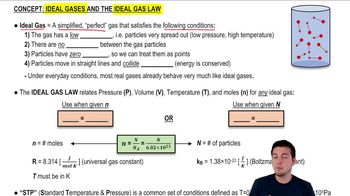
The Ideal Gas Law describes the relationship between pressure, volume, temperature, and the number of moles of an ideal gas, expressed as PV = nRT. This law implies that for a given volume and amount of gas, changes in temperature will affect pressure. Understanding this relationship is crucial for analyzing the conditions in boxes A and B.
Recommended video:
Guided course
07:21
Ideal Gases and the Ideal Gas Law

Kinetic Molecular Theory

Kinetic Molecular Theory explains that the temperature of a gas is directly related to the average kinetic energy of its molecules. Higher temperatures correspond to higher average kinetic energy, which means that the molecules in box A, at 50°C, will have more kinetic energy than those in box B, at 10°C. This concept is essential for evaluating statements about molecular motion and energy.
Recommended video:
Guided course
01:50
Introduction to Kinetic-Molecular Theory

Molecular Speed Distribution

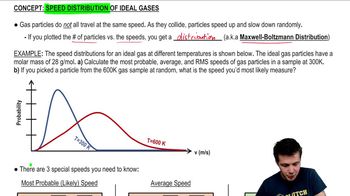
Molecular speed distribution refers to the range of speeds of molecules in a gas, which can be described by the Maxwell-Boltzmann distribution. This concept indicates that at higher temperatures, not only do molecules have higher average speeds, but there is also a greater spread of speeds. This understanding helps in assessing the relative speeds of gas molecules in boxes A and B.
Recommended video:
Guided course
07:59
Speed Distribution & Special Speeds of Ideal Gases