

Ch. 11 - Angular Momentum; General Rotation
Giancoli Douglas - Physics for Scientists and Engineers 5th edition
Giancoli Douglas5th editionPhysics for Scientists and EngineersISBN: 9780137488179Not the one you use?Change textbook
Chapter 11, Problem 85

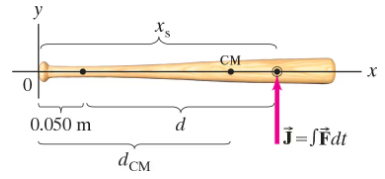
A baseball bat has a sweet spot where a ball can be hit with almost effortless transmission of energy. A careful analysis of baseball dynamics shows that this special spot is located at the point where an applied force would result in pure rotation of the bat about the handle grip. Determine the location of the sweet spot, xₛ, of the bat shown in Fig. 11–53. The linear mass density of the bat is given roughly by (0.61 + 3.3x²) kg/m, where x is in meters measured from the end of the handle. The entire bat is 0.84 m long. The desired rotation point should be 5.0 cm from the thin end where the bat is held. [Hint: Where is the cm of the bat?]

Verified step by step guidance
1
Step 1: Understand the problem. The sweet spot is the point where an applied force results in pure rotation about the handle grip. To find this, we need to calculate the center of mass (cm) of the bat and the moment of inertia about the desired rotation point. The linear mass density is given as \( \lambda(x) = 0.61 + 3.3x^2 \) (in kg/m), where \( x \) is the distance from the handle end. The bat is 0.84 m long, and the rotation point is 5.0 cm (0.05 m) from the handle end.
Step 2: Calculate the total mass of the bat. The total mass \( M \) is the integral of the linear mass density over the length of the bat: \( M = \int_0^{0.84} \lambda(x) dx = \int_0^{0.84} (0.61 + 3.3x^2) dx \). Perform the integration to express \( M \) in terms of the given limits.
Step 3: Determine the center of mass (cm) of the bat. The center of mass \( x_{cm} \) is given by \( x_{cm} = \frac{1}{M} \int_0^{0.84} x \lambda(x) dx \). Substitute \( \lambda(x) = 0.61 + 3.3x^2 \) and integrate \( \int_0^{0.84} x(0.61 + 3.3x^2) dx \) to find \( x_{cm} \).
Step 4: Calculate the moment of inertia about the desired rotation point. The moment of inertia \( I \) is given by \( I = \int_0^{0.84} \lambda(x) (x - 0.05)^2 dx \). Substitute \( \lambda(x) = 0.61 + 3.3x^2 \) and integrate \( \int_0^{0.84} (0.61 + 3.3x^2)(x - 0.05)^2 dx \) to find \( I \).
Step 5: Use the physical condition for the sweet spot. The sweet spot is located where the applied force results in pure rotation about the handle grip. This occurs when the torque due to the center of mass balances the rotational inertia. Solve for \( x_s \) using the relationship between the center of mass, moment of inertia, and the desired rotation point.

Verified video answer for a similar problem:

This video solution was recommended by our tutors as helpful for the problem above.
Video duration:
13m
Was this helpful?

Key Concepts

Here are the essential concepts you must grasp in order to answer the question correctly.

Center of Mass

The center of mass (cm) of an object is the point where its mass is evenly distributed in all directions. For a baseball bat, the cm can be calculated by integrating the mass distribution along its length. Understanding the location of the cm is crucial for determining how forces applied to the bat will affect its motion, particularly in rotational dynamics.
Recommended video:
Guided course
06:30
Intro to Center of Mass

Torque

Torque is a measure of the rotational force applied to an object, calculated as the product of the force and the distance from the pivot point (lever arm). In the context of the baseball bat, the sweet spot is where the applied force results in pure rotation, meaning that the torque about the handle grip is maximized. This concept is essential for analyzing how the bat will rotate when a ball is hit.
Recommended video:
Guided course
08:55
Net Torque & Sign of Torque

Linear Mass Density

Linear mass density is defined as the mass per unit length of an object, which varies along the length of the bat in this case. The given function (0.61 + 3.3x²) kg/m indicates that the mass distribution changes with position, affecting both the center of mass and the moment of inertia. Understanding linear mass density is vital for calculating the bat's dynamics and locating the sweet spot.
Recommended video:
Guided course
04:33
Problems with Mass, Volume, & Density
Related Practice
Textbook Question

A particle of mass m uniformly accelerates as it moves counterclockwise along the circumference of a circle of radius R: r\(\overrightarrow{r}\) = î R cos θ + ĵ R sin θ with θ = ω₀t + (1/2)αt² , where the constants ω₀ and α are the initial angular velocity and angular acceleration, respectively. Determine the object’s tangential acceleration a\(\overrightarrow{a}\)tan and determine the torque acting on the object using τ=r×F\(\overrightarrow{\tau}\)=\(\overrightarrow{r}\]\times\) F.

1207
views
Textbook Question

A radio transmission tower has a mass of 76 kg and is 12 m high. The tower is anchored to the ground by a flexible joint at its base, but it is secured by three cables 120° apart (Fig. 11–52). In an analysis of a potential failure, a mechanical engineer needs to determine the behavior of the tower if one of the cables breaks. The tower would fall away from the broken cable, rotating about its base. Determine the speed of the top of the tower as a function of the rotation angle θ. Start your analysis with the rotational dynamics equation of motion dL\(\overrightarrow{L}\)/dt =τext\(\overrightarrow{\tau_{ext}\)}_{}. Approximate the tower as a tall thin rod.

1547
views
Textbook Question

Water drives a waterwheel (or turbine) of radius R = 3.0 m as shown in Fig. 11–50. The water enters at a speed v₁ = 7.0m/s and exits from the waterwheel at a speed v₂= 3.8 m/s. If the water causes the waterwheel to make one revolution every 6.0 s, how much power is delivered to the wheel?

1541
views