Ch. 15 - Wave Motion
Giancoli Douglas - Physics for Scientists and Engineers 5th edition
Giancoli Douglas5th editionPhysics for Scientists and EngineersISBN: 9780137488179Not the one you use?Change textbook
Chapter 15, Problem 27b

A transverse wave pulse travels to the right along a string with a speed v = 2.0 m/s. At the shape of the pulse is given by the function D = 0.45 cos (2.6x + 1.2), where D and x are in meters. Determine a formula for the wave pulse at any time t assuming there are no frictional losses.

Verified step by step guidance
1
The given wave pulse is described by the function \( D(x, t=0) = 0.45 \cos(2.6x + 1.2) \), where \( D \) is the displacement, \( x \) is the position, and \( t \) is the time. At \( t = 0 \), this represents the initial shape of the wave pulse.
The wave is traveling to the right with a speed \( v = 2.0 \ \text{m/s} \). For a wave traveling to the right, the general form of the wave equation is \( D(x, t) = D(x - vt, 0) \). This means the wave's shape at any time \( t \) is the same as its initial shape, but shifted to the right by a distance \( vt \).
Substitute \( x - vt \) into the given function for \( x \). The new formula becomes \( D(x, t) = 0.45 \cos(2.6(x - vt) + 1.2) \).
Now substitute the value of \( v = 2.0 \ \text{m/s} \) into the equation. This gives \( D(x, t) = 0.45 \cos(2.6(x - 2.0t) + 1.2) \).
Simplify the expression if needed. The final formula for the wave pulse at any time \( t \) is \( D(x, t) = 0.45 \cos(2.6x - 5.2t + 1.2) \). This equation describes the wave pulse as it propagates to the right without any frictional losses.

Verified video answer for a similar problem:

This video solution was recommended by our tutors as helpful for the problem above.
Video duration:
6m
Was this helpful?

Key Concepts

Here are the essential concepts you must grasp in order to answer the question correctly.

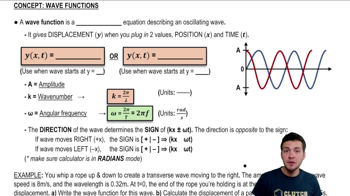
Wave Function

A wave function describes the shape and behavior of a wave at any given point in space and time. In this case, the function D = 0.45 cos(2.6x + 1.2) represents a transverse wave pulse, where D is the displacement of the string and x is the position along the string. The cosine function indicates that the wave oscillates, and its parameters determine the wave's amplitude, wavelength, and phase.
Recommended video:
Guided course
08:30
Intro to Wave Functions

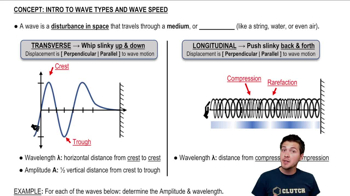
Wave Speed

Wave speed is the rate at which a wave propagates through a medium. It is determined by the properties of the medium and is given in this problem as v = 2.0 m/s. Understanding wave speed is crucial for determining how the wave pulse changes over time, as it affects the relationship between the wave's spatial and temporal characteristics.
Recommended video:
Guided course
07:19
Intro to Waves and Wave Speed

Time Dependence of Waves

To express the wave pulse as a function of time, we need to incorporate the wave speed into the wave function. The general form of a wave traveling in the positive x-direction can be expressed as D(x, t) = A cos(kx - ωt + φ), where A is amplitude, k is the wave number, ω is the angular frequency, and φ is the phase constant. By substituting the given speed and the wave function parameters, we can derive the time-dependent formula for the wave pulse.
Recommended video:
Guided course
07:19
Intro to Waves and Wave Speed