
Ch. 12 - Analysis of Variance
Triola - Elementary Statistics 14th Edition
Triola14th EditionElementary StatisticsISBN: 9780137366446Not the one you use?Change textbook
Chapter 12, Problem 12.1.9

In Exercises 5–16, use analysis of variance for the indicated test.


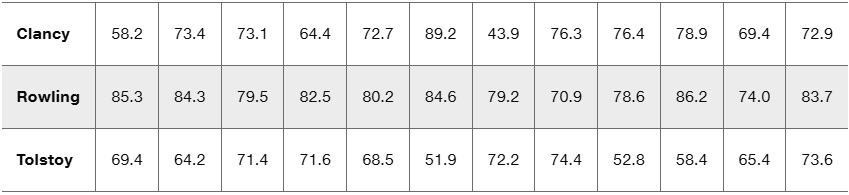
Clancy, Rowling, and Tolstoy Ease of Reading Pages were randomly selected from three books: The Bear and the Dragon by Tom Clancy, Harry Potter and the Sorcerer’s Stone by J.K. Rowling, and War and Peace by Leo Tolstoy. Listed below are Flesch Reading Ease Scores for those pages. Use a 0.05 significance level to test the claim that pages from books by those three authors have the same mean Flesch Reading Ease score. Given that higher scores correspond to text that is easier to read, which author appears to be different, and how is that author different?


Table of Flesch Reading Ease Scores for pages from Clancy, Rowling, and Tolstoy books.

Verified step by step guidance
1
Step 1: Organize the data into groups based on the authors (Clancy, Rowling, Tolstoy). Each group contains the Flesch Reading Ease Scores provided in the table.
Step 2: Calculate the mean Flesch Reading Ease score for each group (author). This involves summing the scores for each author and dividing by the number of scores in that group.
Step 3: Compute the overall mean of all the scores combined. This is done by summing all the scores across the three groups and dividing by the total number of scores.
Step 4: Perform an Analysis of Variance (ANOVA) test. This involves calculating the between-group variance (how much the group means differ from the overall mean) and the within-group variance (how much the scores within each group differ from their respective group mean). Use these variances to compute the F-statistic.
Step 5: Compare the calculated F-statistic to the critical value from the F-distribution table at a 0.05 significance level. If the F-statistic exceeds the critical value, reject the null hypothesis that the means are the same. Identify which author is different by examining the group means and their relationship to the overall mean.

Verified video answer for a similar problem:

This video solution was recommended by our tutors as helpful for the problem above.
Video duration:
3m
Was this helpful?

Key Concepts

Here are the essential concepts you must grasp in order to answer the question correctly.

Analysis of Variance (ANOVA)

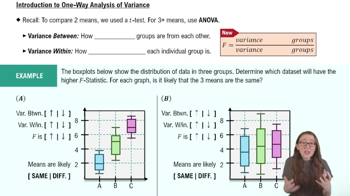
ANOVA is a statistical method used to compare the means of three or more groups to determine if at least one group mean is significantly different from the others. It assesses the impact of one or more factors by comparing the variance within groups to the variance between groups. In this context, ANOVA will help test the claim regarding the Flesch Reading Ease scores of the books by Clancy, Rowling, and Tolstoy.
Recommended video:
06:46
Introduction to ANOVA

Flesch Reading Ease Score

The Flesch Reading Ease Score is a readability test designed to indicate how easy a text is to read. The score is calculated based on the average number of syllables per word and the average number of words per sentence. Higher scores indicate easier readability, which is crucial for understanding how the texts from different authors compare in terms of accessibility to readers.
Recommended video:
Guided course
06:31
Z-Scores From Given Probability - TI-84 (CE) Calculator

Significance Level

The significance level, often denoted as alpha (α), is the threshold for determining whether a statistical result is significant. In this case, a significance level of 0.05 means that there is a 5% risk of concluding that a difference exists when there is none. This level will guide the decision on whether to reject the null hypothesis that the mean Flesch Reading Ease scores of the three authors are the same.
Recommended video:
03:33
Finding Binomial Probabilities Using TI-84 Example 1
Related Practice
Textbook Question

In Exercises 1–4, use the following listed measured amounts of chest compression (mm) from car crash tests (from Data Set 35 “Car Data” in Appendix B). Also shown are the SPSS results from analysis of variance. Assume that we plan to use a 0.05 significance level to test the claim that the different car sizes have the same mean amount of chest compression.

P-VALUE If we use a 0.05 significance level in analysis of variance with the sample data given in Exercise 1, what is the P-value? What should we conclude? If the four populations have means that do not appear to be the same, does the analysis of variance test enable us to identify which populations have means that are significantly different?

21
views
Textbook Question

Cola Weights The displayed results from Exercise 1 are from one-way analysis of variance. What is it about this test that characterizes it as one-way analysis of variance instead of two-way analysis of variance?

109
views
Textbook Question

Tukey Test A display of the Bonferroni test results from Table 12-1 (which is part of the Chapter Problem) is provided here. Shown on the top of the next page is the SPSS-generated display of results from the Tukey test using the same data. Compare the Tukey test results to those from the Bonferroni test.

32
views
Textbook Question

Car Crash Test Measurements If we use the data given in Exercise 1 with two-way analysis of variance and a 0.05 significance level, we get the accompanying display. What do you conclude?

104
views
Textbook Question

Cola Weights For the four samples described in Exercise 1, the sample of regular Coke has a mean weight of 0.81682 lb, the sample of Diet Coke has a mean weight of 0.78479 lb, the sample of regular Pepsi has a mean weight of 0.82410 lb, and the sample of Diet Pepsi has a mean weight of 0.78386 lb. If we use analysis of variance and reach a conclusion to reject equality of the four sample means, can we then conclude that any of the specific samples have means that are significantly different from the others?

99
views
Textbook Question

Cola Weights Data Set 37 “Cola Weights and Volumes” in Appendix B lists the weights (lb) of the contents of cans of cola from four different samples: (1) regular Coke, (2) Diet Coke, (3) regular Pepsi, and (4) Diet Pepsi. The results from analysis of variance are shown in the Minitab display below. What is the null hypothesis for this analysis of variance test? Based on the displayed results, what should you conclude about H_knot. What do you conclude about equality of the mean weights from the four samples?

161
views