


Ch. 11 - Goodness-of-Fit and Contingency Tables
Triola - Elementary Statistics 14th Edition
Triola14th EditionElementary StatisticsISBN: 9780137366446Not the one you use?Change textbook
Chapter 11, Problem 11.1.6

In Exercises 5–20, conduct the hypothesis test and provide the test statistic and the P-value and/or critical value, and state the conclusion.


Heights Measured or Reported? Repeat the preceding exercise using the frequencies in the following table, which summarizes all of the 2784 male heights listed in Data Set 4 “Measured and Reported.” Does the larger data set have much of an effect on the results from Exercise 5?
<IMAGE>

Verified step by step guidance
1
Step 1: Define the null and alternative hypotheses. The null hypothesis (H₀) states that the last digits of the heights are uniformly distributed, meaning each digit (0 through 9) has an equal probability of occurrence. The alternative hypothesis (H₁) states that the last digits are not uniformly distributed.
Step 2: Calculate the expected frequency for each digit under the assumption of uniform distribution. Since there are 2784 total heights, divide this total by 10 (the number of digits) to find the expected frequency for each digit: Expected Frequency = 2784 ÷ 10 = 278.4.
Step 3: Use the observed frequencies from the table and the expected frequencies to calculate the test statistic. The test statistic for a chi-square goodness-of-fit test is given by: χ2 = Σ((Oᵢ - Eᵢ)² / Eᵢ), where Oᵢ represents the observed frequency and Eᵢ represents the expected frequency for each digit.
Step 4: Determine the degrees of freedom (df) for the chi-square test. The degrees of freedom are calculated as df = k - 1, where k is the number of categories (digits). In this case, df = 10 - 1 = 9.
Step 5: Compare the calculated test statistic to the critical value from the chi-square distribution table at the chosen significance level (e.g., α = 0.05) or use the P-value to make a decision. If the test statistic exceeds the critical value or if the P-value is less than α, reject the null hypothesis. Otherwise, fail to reject the null hypothesis.

Verified video answer for a similar problem:

This video solution was recommended by our tutors as helpful for the problem above.
Video duration:
1m
Was this helpful?

Key Concepts

Here are the essential concepts you must grasp in order to answer the question correctly.

Hypothesis Testing

Hypothesis testing is a statistical method used to make decisions about a population based on sample data. It involves formulating a null hypothesis (H0) and an alternative hypothesis (H1), then using sample data to determine whether to reject H0. The process includes calculating a test statistic and comparing it to a critical value or using a P-value to assess the strength of the evidence against H0.
Recommended video:
Guided course
06:21
Step 1: Write Hypotheses

Test Statistic

A test statistic is a standardized value that is calculated from sample data during a hypothesis test. It measures how far the sample statistic is from the null hypothesis, expressed in terms of standard errors. Depending on the type of test (e.g., z-test, t-test), the test statistic helps determine whether to reject the null hypothesis by comparing it to a critical value or using it to find the P-value.
Recommended video:
Guided course
06:34
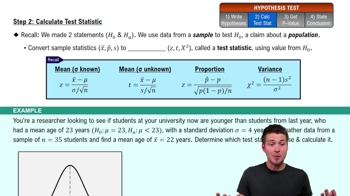
Step 2: Calculate Test Statistic

P-value

The P-value is the probability of obtaining a test statistic at least as extreme as the one observed, assuming the null hypothesis is true. It quantifies the evidence against the null hypothesis; a smaller P-value indicates stronger evidence. In hypothesis testing, if the P-value is less than the significance level (commonly 0.05), the null hypothesis is rejected, suggesting that the observed data is unlikely under H0.
Recommended video:
Guided course
06:50
Step 3: Get P-Value
Related Practice
Textbook Question

In Exercises 5–20, conduct the hypothesis test and provide the test statistic and the P-value and/or critical value, and state the conclusion.


Bias in Clinical Trials? Researchers investigated the issue of race and equality of access to clinical trials. The following table shows the population distribution and the numbers of participants in clinical trials involving lung cancer (based on data from “Participation in Cancer Clinical Trials,” by Murthy, Krumholz, and Gross, Journal of the American Medical Association, Vol. 291, No. 22). Use a 0.01 significance level to test the claim that the distribution of clinical trial participants fits well with the population distribution. Is there a race/ethnic group that appears to be very underrepresented?


112
views
Textbook Question

In Exercises 5–20, conduct the hypothesis test and provide the test statistic and the P-value and/or critical value, and state the conclusion.


Testing a Slot Machine The author purchased a slot machine (Bally Model 809) and tested it by playing it 1197 times. There are 10 different categories of outcomes, including no win, win jackpot, win with three bells, and so on. When testing the claim that the observed outcomes agree with the expected frequencies, the author obtained a test statistic of x2 = 8.815 Use a 0.05 significance level to test the claim that the actual outcomes agree with the expected frequencies. Does the slot machine appear to be functioning as expected?

139
views
Textbook Question

Identifying Hypotheses Refer to the data given in Exercise 1 and assume that the requirements are all satisfied and we want to conduct a hypothesis test of independence using the methods of this section. Identify the null and alternative hypotheses.

149
views
Textbook Question

Dogs Detecting Malaria The following table lists results from an experiment designed to test the ability of dogs to use their extraordinary sense of smell to detect malaria in samples of children’s socks (based on data presented at an annual meeting of the American Society of Tropical Medicine, by principal investigator Steve Lindsay). Assuming that the dog being correct is independent of whether malaria is present, find the expected value for the observed frequency of 123.


145
views
Textbook Question

Benford’s Law

According to Benford’s law, a variety of different data sets include numbers with leading (first) digits that follow the distribution shown in the table below. In Exercises 21–24, test for goodness-of-fit with the distribution described by Benford’s law.


Detecting Fraud When working for the Brooklyn district attorney, investigator Robert Burton analyzed the leading digits of the amounts from 784 checks issued by seven suspect companies. The frequencies were found to be 0, 15, 0, 76, 479, 183, 8, 23, and 0, and those digits correspond to the leading digits of 1, 2, 3, 4, 5, 6, 7, 8, and 9, respectively. If the observed frequencies are substantially different from the frequencies expected with Benford’s law, the check amounts appear to result from fraud. Use a 0.01 significance level to test for goodness-of-fit with Benford’s law. Does it appear that the checks are the result of fraud?

216
views
Textbook Question

Equivalent Tests A x^2 test involving a 2 x 2 table is equivalent to the test for the difference between two proportions, as described in Section 9-1. Using Table 11-1 from the Chapter Problem, verify that the x^2 test statistic and the z test statistic (found from the test of equality of two proportions) are related as follows: z^2 = x^2 Also show that the critical values have that same relationship.

157
views