Ch. 4 - Probability
Triola - Elementary Statistics 14th Edition
Triola14th EditionElementary StatisticsISBN: 9780137366446Not the one you use?Change textbook
Chapter 4, Problem 4.2.18

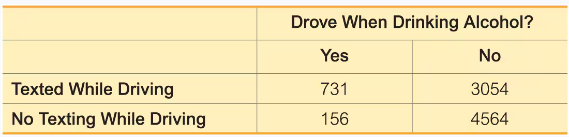
In Exercises 9–20, use the data in the following table, which lists survey results from high school drivers at least 16 years of age (based on data from “Texting While Driving and Other Risky Motor Vehicle Behaviors Among U.S. High School Students,” by O’Malley, Shults, and Eaton, Pediatrics, Vol. 131, No. 6). Assume that subjects are randomly selected from those included in the table. Hint: Be very careful to read the question correctly.
Survey table of high school drivers: texting and driving vs. drinking and driving, with numerical data.
Texting and Alcohol If one of the high school drivers is randomly selected, find the probability that the selected driver did not text while driving and did not drive when drinking.

Verified step by step guidance
1
Step 1: Identify the relevant data from the table. The problem asks for the probability that a randomly selected driver did not text while driving and did not drive when drinking. From the table, the number of drivers who meet this criterion is found in the 'No Texting While Driving' row and 'No' column, which is 4564.
Step 2: Calculate the total number of high school drivers surveyed. Add all the values in the table: 731 (Texted While Driving and Drove When Drinking) + 3054 (Texted While Driving and Did Not Drive When Drinking) + 156 (No Texting While Driving and Drove When Drinking) + 4564 (No Texting While Driving and Did Not Drive When Drinking).
Step 3: Use the formula for probability: \( P(A) = \frac{\text{Number of favorable outcomes}}{\text{Total number of outcomes}} \). Here, the favorable outcome is the number of drivers who did not text while driving and did not drive when drinking (4564), and the total number of outcomes is the total number of drivers surveyed (calculated in Step 2).
Step 4: Substitute the values into the probability formula. The numerator is 4564, and the denominator is the total number of drivers surveyed (calculated in Step 2).
Step 5: Simplify the fraction to express the probability. If needed, convert the fraction to a decimal or percentage for interpretation.

Verified video answer for a similar problem:

This video solution was recommended by our tutors as helpful for the problem above.
Video duration:
2m
Was this helpful?

Key Concepts

Here are the essential concepts you must grasp in order to answer the question correctly.

Probability

Probability is a measure of the likelihood that a particular event will occur, expressed as a number between 0 and 1. In this context, it involves calculating the chance that a randomly selected high school driver did not text while driving and did not drive after drinking alcohol. This requires understanding how to use the total number of favorable outcomes relative to the total number of possible outcomes.
Recommended video:
5:37
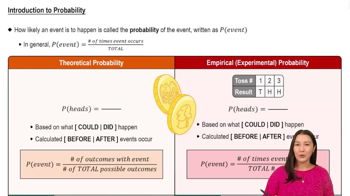
Introduction to Probability

Contingency Table

A contingency table is a type of data representation that displays the frequency distribution of variables. In this case, the table shows the relationship between texting while driving and driving after drinking alcohol. Analyzing this table helps in determining the joint and marginal probabilities necessary for solving the problem.
Recommended video:
Guided course
09:47
Finding Standard Normal Probabilities using z-Table

Complementary Events

Complementary events are pairs of outcomes where one event occurs if and only if the other does not. In this scenario, the event of interest is that a driver did not text while driving and did not drive after drinking. Understanding complementary events is crucial for calculating the probability of the desired outcome by subtracting the probability of the opposite event from 1.
Recommended video:
4:23
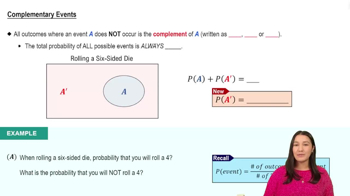
Complementary Events
Related Practice
Textbook Question

Probability of a Girl Assuming that boys and girls are equally likely, find the probability of a couple having a boy when their third child is born, given that the first two children were both girls.

233
views

Textbook Question

In Exercises 33–40, use the given probability value to determine whether the sample results are significant.


Voting Repeat the preceding Exercise 33 after replacing 40 Democrats being placed on the first line of voting ballots with 26 Democrats being placed on the first line. The probability of getting a result as high as 26 is 0.058638.

117
views
Textbook Question

Women in Movies In a recent year, speaking characters in movies were 68.2% male. What is the probability of randomly selecting a character with a speaking part and getting a female? What should be the value of that probability?

138
views
Textbook Question

Teed Off When four golfers are about to begin a game, they often toss a tee to randomly select the order in which they tee off. What is the probability that they tee off in alphabetical order by last name?

122
views
Textbook Question

Quinela In a horse race, a quinela bet is won if you selected the two horses that finish first and second, and they can be selected in any order. The 144th running of the Kentucky Derby had a field of 20 horses. What is the probability of winning a quinela bet if you randomly select the horses?

193
views
Textbook Question

Mendel’s Peas Mendel conducted some of his famous experiments with peas that were either smooth yellow plants or wrinkly green plants. If four peas are randomly selected from a batch consisting of four smooth yellow plants and four wrinkly green plants, find the probability that the four selected peas are of the same type.

135
views