Ch. 5 - Normal Probability Distributions
Larson - Elementary Statistics: Picturing the World 8th Edition
Larson8th EditionElementary Statistics: Picturing the WorldISBN: 9780137493470Not the one you use?Change textbook
Chapter 5, Problem 5.RE.11

In Exercises 7–18, find the indicated area under the standard normal curve. If convenient, use technology to find the area.


To the left of z = -2.825

Verified step by step guidance
1
Step 1: Understand the problem. You are tasked with finding the area under the standard normal curve to the left of z = -2.825. The standard normal curve is a bell-shaped curve with a mean of 0 and a standard deviation of 1.
Step 2: Recall that the area under the standard normal curve represents probabilities. To find the area to the left of a given z-score, you can use a z-table (standard normal table) or technology such as a graphing calculator or statistical software.
Step 3: If using a z-table, locate the row corresponding to the first two digits of the z-score (-2.8) and the column corresponding to the hundredths place (0.025). The intersection of this row and column gives the cumulative probability to the left of z = -2.825.
Step 4: If using technology, input the z-score (-2.825) into the cumulative distribution function (CDF) for the standard normal distribution. For example, in a graphing calculator, use the function normcdf(-∞, -2.825, 0, 1), where -∞ represents the lower bound, 0 is the mean, and 1 is the standard deviation.
Step 5: Interpret the result. The value obtained represents the proportion of the data under the standard normal curve that lies to the left of z = -2.825. This is the desired area.

Verified video answer for a similar problem:

This video solution was recommended by our tutors as helpful for the problem above.
Video duration:
3m
Was this helpful?

Key Concepts

Here are the essential concepts you must grasp in order to answer the question correctly.

Standard Normal Distribution

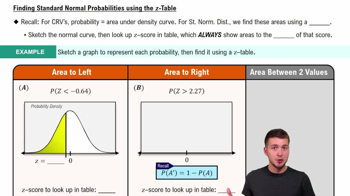
The standard normal distribution is a special normal distribution with a mean of 0 and a standard deviation of 1. It is used to describe how data is distributed in a standardized way, allowing for comparison across different datasets. The z-score indicates how many standard deviations an element is from the mean, facilitating the calculation of probabilities and areas under the curve.
Recommended video:
Guided course
09:47
Finding Standard Normal Probabilities using z-Table

Z-Score

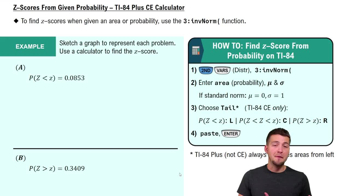
A z-score is a statistical measurement that describes a value's relationship to the mean of a group of values. It is calculated by subtracting the mean from the value and then dividing by the standard deviation. In the context of the standard normal distribution, a z-score of -2.825 indicates that the value is 2.825 standard deviations below the mean, which is essential for determining the area under the curve to the left of this z-score.
Recommended video:
Guided course
06:31
Z-Scores From Given Probability - TI-84 (CE) Calculator

Area Under the Curve

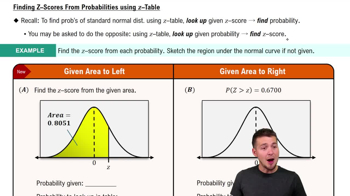
The area under the curve in a standard normal distribution represents the probability of a random variable falling within a certain range. For a given z-score, this area can be found using statistical tables or technology, such as calculators or software. In this case, finding the area to the left of z = -2.825 helps determine the likelihood of a value being less than this z-score, which is crucial for various statistical analyses.
Recommended video:
Guided course
08:50
Z-Scores from Probabilities