Forming License Plate Numbers How many different license plate numbers can be made by using one letter followed by five digits selected from the digits 0 through 9?
Table of contents
- 1. Intro to Stats and Collecting Data1h 14m
- 2. Describing Data with Tables and Graphs1h 55m
- 3. Describing Data Numerically2h 5m
- 4. Probability2h 16m
- 5. Binomial Distribution & Discrete Random Variables3h 6m
- 6. Normal Distribution and Continuous Random Variables2h 11m
- 7. Sampling Distributions & Confidence Intervals: Mean3h 23m
- Sampling Distribution of the Sample Mean and Central Limit Theorem19m
- Distribution of Sample Mean - Excel23m
- Introduction to Confidence Intervals15m
- Confidence Intervals for Population Mean1h 18m
- Determining the Minimum Sample Size Required12m
- Finding Probabilities and T Critical Values - Excel28m
- Confidence Intervals for Population Means - Excel25m
- 8. Sampling Distributions & Confidence Intervals: Proportion1h 25m
- 9. Hypothesis Testing for One Sample3h 29m
- 10. Hypothesis Testing for Two Samples4h 50m
- Two Proportions1h 13m
- Two Proportions Hypothesis Test - Excel28m
- Two Means - Unknown, Unequal Variance1h 3m
- Two Means - Unknown Variances Hypothesis Test - Excel12m
- Two Means - Unknown, Equal Variance15m
- Two Means - Unknown, Equal Variances Hypothesis Test - Excel9m
- Two Means - Known Variance12m
- Two Means - Sigma Known Hypothesis Test - Excel21m
- Two Means - Matched Pairs (Dependent Samples)42m
- Matched Pairs Hypothesis Test - Excel12m
- 11. Correlation1h 24m
- 12. Regression1h 50m
- 13. Chi-Square Tests & Goodness of Fit2h 21m
- 14. ANOVA1h 57m
4. Probability
Fundamental Counting Principle
Problem 5.5.71b
Textbook Question
ID Numbering
The Federal Bureau of Investigation (FBI) maintains a records system that stores civil background checks and criminal histories in a database. Each file has its own identification number (ID). With the initial system for generating IDs, the system would generate only 400 million unique IDs. Because this was not sufficient for the number of individuals in the database, more numbers were needed. The new algorithm uses eight characters, where each character can be a digit from 0 to 9 or one of 17 letters of the alphabet (letters that can be confused with numbers, like the number 1 and letter I, are excluded).
b. The FBI does not allow the first character to be 0. To the nearest billion, how many identification numbers are possible?
Verified step by step guidance1
Identify the total number of possible characters for each position in the ID. Each character can be a digit (0-9) or one of 17 letters, so the total number of possible characters per position is \$10 + 17 = 27$.
Since the ID has 8 characters, if there were no restrictions, the total number of possible IDs would be \$27^8$.
However, the first character cannot be 0. Since digits include 0-9, the first character can be any of the 27 characters except 0, so the number of options for the first character is \$27 - 1 = 26$.
For the remaining 7 characters, there are no restrictions, so each can be any of the 27 possible characters.
Calculate the total number of possible IDs by multiplying the number of options for the first character by the number of options for the remaining characters: \$26 \times 27^7$. This gives the total number of valid IDs under the given restriction.
Verified video answer for a similar problem:This video solution was recommended by our tutors as helpful for the problem above
Video duration:
2mPlay a video:
Was this helpful?
Key Concepts
Here are the essential concepts you must grasp in order to answer the question correctly.
Counting Principle (Multiplication Rule)
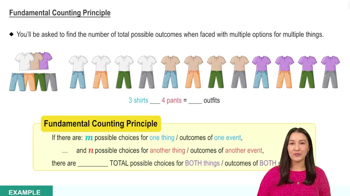
The counting principle states that if there are multiple stages in a process, the total number of outcomes is the product of the number of choices at each stage. For example, if each character in an ID can be chosen independently, the total number of IDs is the product of the number of options for each character.
Recommended video:
Fundamental Counting Principle
Permutations with Restrictions
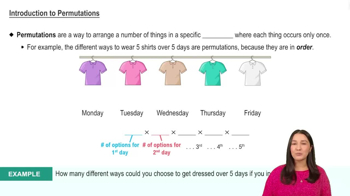
When generating sequences like ID numbers, restrictions on certain positions (e.g., the first character cannot be 0) reduce the number of possible outcomes. This requires adjusting the count for that position while keeping the counts for other positions unchanged.
Recommended video:
Introduction to Permutations
Base Counting Systems and Character Sets
The total number of possible IDs depends on the size of the character set for each position. Here, each character can be a digit (0-9) or one of 17 letters, excluding confusing characters, making a total of 27 possible characters per position, except where restrictions apply.
Recommended video:
Introduction to Permutations
Watch next
Master Fundamental Counting Principle with a bite sized video explanation from Patrick
Start learningRelated Videos
Related Practice
Textbook Question
3
views