User Names How many user names are possible in Problem 41 if the last character must be a digit?
Table of contents
- 1. Intro to Stats and Collecting Data1h 14m
- 2. Describing Data with Tables and Graphs1h 55m
- 3. Describing Data Numerically2h 5m
- 4. Probability2h 16m
- 5. Binomial Distribution & Discrete Random Variables3h 6m
- 6. Normal Distribution and Continuous Random Variables2h 11m
- 7. Sampling Distributions & Confidence Intervals: Mean3h 23m
- Sampling Distribution of the Sample Mean and Central Limit Theorem19m
- Distribution of Sample Mean - Excel23m
- Introduction to Confidence Intervals15m
- Confidence Intervals for Population Mean1h 18m
- Determining the Minimum Sample Size Required12m
- Finding Probabilities and T Critical Values - Excel28m
- Confidence Intervals for Population Means - Excel25m
- 8. Sampling Distributions & Confidence Intervals: Proportion1h 25m
- 9. Hypothesis Testing for One Sample3h 29m
- 10. Hypothesis Testing for Two Samples4h 50m
- Two Proportions1h 13m
- Two Proportions Hypothesis Test - Excel28m
- Two Means - Unknown, Unequal Variance1h 3m
- Two Means - Unknown Variances Hypothesis Test - Excel12m
- Two Means - Unknown, Equal Variance15m
- Two Means - Unknown, Equal Variances Hypothesis Test - Excel9m
- Two Means - Known Variance12m
- Two Means - Sigma Known Hypothesis Test - Excel21m
- Two Means - Matched Pairs (Dependent Samples)42m
- Matched Pairs Hypothesis Test - Excel12m
- 11. Correlation1h 24m
- 12. Regression1h 50m
- 13. Chi-Square Tests & Goodness of Fit2h 21m
- 14. ANOVA1h 57m
4. Probability
Fundamental Counting Principle
Problem 5.4.33a
Textbook Question
"The Birthday Problem
Determine the probability that at least 2 people in a room of 10 people share the same birthday, ignoring leap years and assuming each birthday is equally likely, by answering the following questions:
a. Compute the probability that 10 people have 10 different birthdays. Hint: The first person's birthday can occur 365 ways, the second person's birthday can occur 364 ways, because he or she cannot have the same birthday as the first person, the third person's birthday can occur 363 ways, because he or she cannot have the same birthday as the first or second person, and so on.
"
Verified step by step guidance1
Understand the problem: We want to find the probability that at least two people in a group of 10 share the same birthday. To do this, it's easier first to find the probability that all 10 people have different birthdays, then use the complement rule.
Calculate the total number of possible birthday assignments for 10 people, assuming each person can have any of the 365 birthdays independently. This total number is \$365^{10}$.
Calculate the number of favorable outcomes where all 10 people have different birthdays. For the first person, there are 365 possible birthdays, for the second person 364 (since they cannot share the first person's birthday), for the third 363, and so on, down to the tenth person who has \$365 - 9 = 356\( possible birthdays. So, the number of favorable outcomes is \)365 \times 364 \times 363 \times \cdots \times 356$.
Express the probability that all 10 people have different birthdays as the ratio of favorable outcomes to total possible outcomes:
\(P(\text{all different}) = \frac{365 \times 364 \times 363 \times \cdots \times 356}{365^{10}}\)
This probability can also be written using factorial notation as:
\(P(\text{all different}) = \frac{\frac{365!}{(365 - 10)!}}{365^{10}}\)
This completes the calculation for part (a).
Verified video answer for a similar problem:This video solution was recommended by our tutors as helpful for the problem above
Video duration:
2mPlay a video:
Was this helpful?
Key Concepts
Here are the essential concepts you must grasp in order to answer the question correctly.
Complement Rule in Probability
The complement rule states that the probability of an event occurring is one minus the probability that it does not occur. In the Birthday Problem, it's easier to calculate the probability that no two people share a birthday and then subtract this from 1 to find the probability that at least two people share a birthday.
Recommended video:
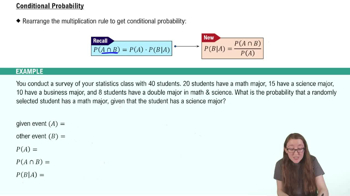
Conditional Probability Rule
Counting Principles and Permutations
Counting principles help determine the number of ways events can occur. For the Birthday Problem, permutations are used to count the number of ways 10 people can have distinct birthdays by multiplying decreasing available options (365, 364, 363, etc.), reflecting the restriction that no birthdays repeat.
Recommended video:
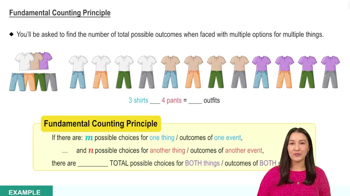
Fundamental Counting Principle
Uniform Probability Distribution
This assumes each birthday is equally likely, with a probability of 1/365 for each day, ignoring leap years. This uniformity allows for straightforward calculation of probabilities by treating each birthday as an independent and equally probable event.
Recommended video:
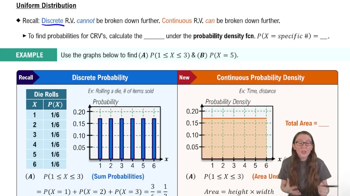
Uniform Distribution
Watch next
Master Fundamental Counting Principle with a bite sized video explanation from Patrick
Start learningRelated Videos
Related Practice
Textbook Question
10
views