If you constructed one hundred 95% confidence intervals based on one hundred different simple random samples of size n, how many of the intervals would you expect to include the unknown parameter? Assume all model requirements are satisfied.
Table of contents
- 1. Intro to Stats and Collecting Data1h 14m
- 2. Describing Data with Tables and Graphs1h 55m
- 3. Describing Data Numerically2h 5m
- 4. Probability2h 16m
- 5. Binomial Distribution & Discrete Random Variables3h 6m
- 6. Normal Distribution and Continuous Random Variables2h 11m
- 7. Sampling Distributions & Confidence Intervals: Mean3h 23m
- Sampling Distribution of the Sample Mean and Central Limit Theorem19m
- Distribution of Sample Mean - Excel23m
- Introduction to Confidence Intervals15m
- Confidence Intervals for Population Mean1h 18m
- Determining the Minimum Sample Size Required12m
- Finding Probabilities and T Critical Values - Excel28m
- Confidence Intervals for Population Means - Excel25m
- 8. Sampling Distributions & Confidence Intervals: Proportion1h 25m
- 9. Hypothesis Testing for One Sample3h 29m
- 10. Hypothesis Testing for Two Samples4h 50m
- Two Proportions1h 13m
- Two Proportions Hypothesis Test - Excel28m
- Two Means - Unknown, Unequal Variance1h 3m
- Two Means - Unknown Variances Hypothesis Test - Excel12m
- Two Means - Unknown, Equal Variance15m
- Two Means - Unknown, Equal Variances Hypothesis Test - Excel9m
- Two Means - Known Variance12m
- Two Means - Sigma Known Hypothesis Test - Excel21m
- Two Means - Matched Pairs (Dependent Samples)42m
- Matched Pairs Hypothesis Test - Excel12m
- 11. Correlation1h 24m
- 12. Regression1h 50m
- 13. Chi-Square Tests & Goodness of Fit2h 21m
- 14. ANOVA1h 57m
8. Sampling Distributions & Confidence Intervals: Proportion
Confidence Intervals for Population Proportion
Problem 9.1.50
Textbook Question
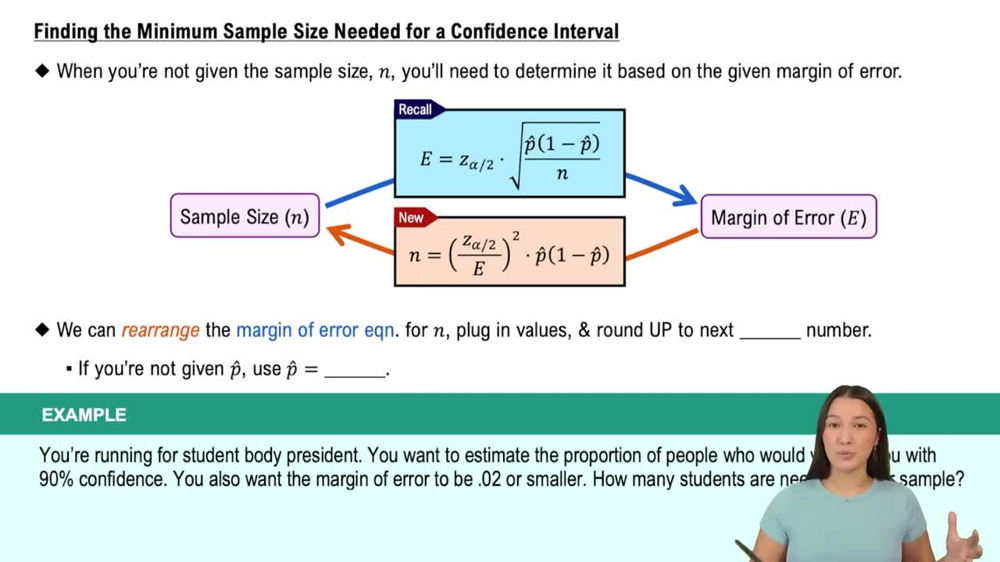
Explain why quadrupling the sample size causes the margin of error to be cut in half.
Verified step by step guidance1
Recall that the margin of error (ME) in estimating a population parameter using a sample is often given by the formula: \(\text{ME} = z^* \times \frac{\sigma}{\sqrt{n}}\), where \(z^*\) is the critical value, \(\sigma\) is the population standard deviation, and \(n\) is the sample size.
Notice that the margin of error is inversely proportional to the square root of the sample size, \(\sqrt{n}\). This means that as the sample size increases, the margin of error decreases, but not linearly—rather, it decreases with the square root of \(n\).
If we quadruple the sample size, the new sample size becomes \$4n\(. Substitute this into the denominator under the square root: \)\sqrt{4n} = 2\sqrt{n}$.
Because the denominator doubles (from \(\sqrt{n}\) to \$2\sqrt{n}\(), the entire fraction \)\frac{\sigma}{\sqrt{n}}$ is cut in half. Since the margin of error is directly proportional to this fraction, the margin of error is also cut in half.
Therefore, quadrupling the sample size reduces the margin of error by a factor of \(\frac{1}{2}\), explaining why the margin of error is halved.
Verified video answer for a similar problem:This video solution was recommended by our tutors as helpful for the problem above
Video duration:
3mPlay a video:
Was this helpful?
Key Concepts
Here are the essential concepts you must grasp in order to answer the question correctly.
Margin of Error
The margin of error quantifies the range within which the true population parameter is expected to lie, based on a sample statistic. It reflects the uncertainty in estimates and is influenced by sample size, variability, and confidence level.
Recommended video:
Finding the Minimum Sample Size Needed for a Confidence Interval
Sample Size and Its Effect on Variability
Increasing the sample size reduces the variability of the sample mean or proportion, leading to more precise estimates. Larger samples provide more information, which decreases the standard error and thus narrows the margin of error.
Recommended video:
Finding the Minimum Sample Size Needed for a Confidence Interval
Relationship Between Sample Size and Margin of Error
The margin of error is inversely proportional to the square root of the sample size. Quadrupling the sample size increases the denominator by a factor of two (since √4=2), which cuts the margin of error in half, improving estimate precision.
Recommended video:
Finding the Minimum Sample Size Needed for a Confidence Interval
Watch next
Master Constructing Confidence Intervals for Proportions with a bite sized video explanation from Patrick
Start learningRelated Videos
Related Practice
Textbook Question
6
views