True or False: A 95% confidence interval for a population proportion with lower bound 0.45 and upper bound 0.51 means there is a 95% probability the population proportion is between 0.45 and 0.51.
Table of contents
- 1. Intro to Stats and Collecting Data1h 14m
- 2. Describing Data with Tables and Graphs1h 55m
- 3. Describing Data Numerically2h 5m
- 4. Probability2h 16m
- 5. Binomial Distribution & Discrete Random Variables3h 6m
- 6. Normal Distribution and Continuous Random Variables2h 11m
- 7. Sampling Distributions & Confidence Intervals: Mean3h 23m
- Sampling Distribution of the Sample Mean and Central Limit Theorem19m
- Distribution of Sample Mean - Excel23m
- Introduction to Confidence Intervals15m
- Confidence Intervals for Population Mean1h 18m
- Determining the Minimum Sample Size Required12m
- Finding Probabilities and T Critical Values - Excel28m
- Confidence Intervals for Population Means - Excel25m
- 8. Sampling Distributions & Confidence Intervals: Proportion1h 25m
- 9. Hypothesis Testing for One Sample3h 29m
- 10. Hypothesis Testing for Two Samples4h 50m
- Two Proportions1h 13m
- Two Proportions Hypothesis Test - Excel28m
- Two Means - Unknown, Unequal Variance1h 3m
- Two Means - Unknown Variances Hypothesis Test - Excel12m
- Two Means - Unknown, Equal Variance15m
- Two Means - Unknown, Equal Variances Hypothesis Test - Excel9m
- Two Means - Known Variance12m
- Two Means - Sigma Known Hypothesis Test - Excel21m
- Two Means - Matched Pairs (Dependent Samples)42m
- Matched Pairs Hypothesis Test - Excel12m
- 11. Correlation1h 24m
- 12. Regression1h 50m
- 13. Chi-Square Tests & Goodness of Fit2h 21m
- 14. ANOVA1h 57m
8. Sampling Distributions & Confidence Intervals: Proportion
Confidence Intervals for Population Proportion
Problem 9.1.54
Textbook Question
The 116th House of Representatives of the United States of America has 435 members, of which 106 are women. An alien lands near the U.S. Capitol and treats members of the House as a random sample of the human race. He reports to his superiors that a 95% confidence interval for the proportion of the human race that is female has a lower bound of 0.203 and an upper bound of 0.284. What is wrong with the alien’s approach to estimating the proportion of the human race that is female?
Verified step by step guidance1
Step 1: Understand the context of the problem. The alien treats the 435 members of the House of Representatives as a random sample of the entire human race, which is a key assumption in constructing confidence intervals for population proportions.
Step 2: Recognize that the House of Representatives is not a random sample of the human race. It is a specific group selected based on political, demographic, and legal criteria, and it only represents a small subset of the U.S. population, not the global population.
Step 3: Recall the conditions for constructing a valid confidence interval for a population proportion. One important condition is that the sample must be randomly selected from the population of interest to ensure representativeness and unbiased estimation.
Step 4: Identify the error in the alien’s approach: using a non-random, non-representative sample (the House members) to estimate the proportion of females in the entire human race violates the random sampling assumption, making the confidence interval invalid for that purpose.
Step 5: Conclude that the confidence interval calculated from the House members' data can only be interpreted as an estimate of the proportion of females in that specific group, not the entire human race.
Verified video answer for a similar problem:This video solution was recommended by our tutors as helpful for the problem above
Video duration:
1mPlay a video:
Was this helpful?
Key Concepts
Here are the essential concepts you must grasp in order to answer the question correctly.
Sampling Bias
Sampling bias occurs when the sample is not representative of the population being studied. In this case, the 116th House of Representatives is a specific group with selection criteria, not a random sample of the entire human race, so conclusions about the global female proportion based on this group are invalid.
Recommended video:
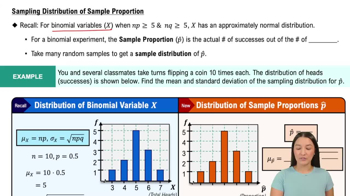
Sampling Distribution of Sample Proportion
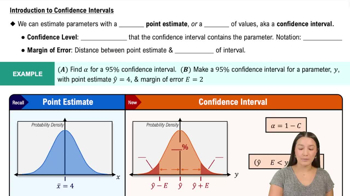
Confidence Interval Interpretation
A confidence interval estimates a population parameter based on a random sample. It assumes the sample is representative and randomly selected. Using a confidence interval from a biased or non-random sample leads to misleading or incorrect inferences about the population.
Recommended video:
Introduction to Confidence Intervals
Population vs. Sample
The population is the entire group of interest, while a sample is a subset used to make inferences about the population. The House of Representatives is a small, non-random subset of humans, so treating it as a sample of the entire human race ignores differences in demographics and selection processes.
Recommended video:
Sampling Distribution of Sample Proportion
Watch next
Master Constructing Confidence Intervals for Proportions with a bite sized video explanation from Patrick
Start learningRelated Videos
Related Practice
Textbook Question
4
views