True or False: Inferences based on voluntary response samples are generally not reliable.
Table of contents
- 1. Intro to Stats and Collecting Data1h 14m
- 2. Describing Data with Tables and Graphs1h 55m
- 3. Describing Data Numerically2h 5m
- 4. Probability2h 16m
- 5. Binomial Distribution & Discrete Random Variables3h 6m
- 6. Normal Distribution and Continuous Random Variables2h 11m
- 7. Sampling Distributions & Confidence Intervals: Mean3h 23m
- Sampling Distribution of the Sample Mean and Central Limit Theorem19m
- Distribution of Sample Mean - Excel23m
- Introduction to Confidence Intervals15m
- Confidence Intervals for Population Mean1h 18m
- Determining the Minimum Sample Size Required12m
- Finding Probabilities and T Critical Values - Excel28m
- Confidence Intervals for Population Means - Excel25m
- 8. Sampling Distributions & Confidence Intervals: Proportion1h 25m
- 9. Hypothesis Testing for One Sample3h 29m
- 10. Hypothesis Testing for Two Samples4h 50m
- Two Proportions1h 13m
- Two Proportions Hypothesis Test - Excel28m
- Two Means - Unknown, Unequal Variance1h 3m
- Two Means - Unknown Variances Hypothesis Test - Excel12m
- Two Means - Unknown, Equal Variance15m
- Two Means - Unknown, Equal Variances Hypothesis Test - Excel9m
- Two Means - Known Variance12m
- Two Means - Sigma Known Hypothesis Test - Excel21m
- Two Means - Matched Pairs (Dependent Samples)42m
- Matched Pairs Hypothesis Test - Excel12m
- 11. Correlation1h 24m
- 12. Regression1h 50m
- 13. Chi-Square Tests & Goodness of Fit2h 21m
- 14. ANOVA1h 57m
1. Intro to Stats and Collecting Data
Sampling Methods
Problem 1.4.32
Textbook Question
Sample Design A school board at a local community college is considering raising the student services fees. The board wants to obtain the opinion of the student body before proceeding. Design a sampling method to obtain the individuals in the sample. Be sure to support your choice.
Verified step by step guidance1
Step 1: Identify the population of interest, which in this case is the entire student body at the local community college. This ensures that the sample represents the group whose opinion the school board wants to understand.
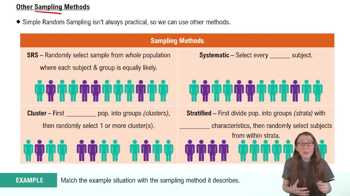
Step 2: Consider different sampling methods such as simple random sampling, stratified sampling, cluster sampling, or systematic sampling. Each method has its own advantages depending on the population structure and the goal of the study.
Step 3: Choose a sampling method that ensures representativeness and fairness. For example, stratified sampling could be used if the student body is divided into distinct groups (e.g., by year, program, or campus), ensuring each subgroup is proportionally represented in the sample.
Step 4: Define the sampling procedure clearly. For stratified sampling, this involves dividing the student body into strata, determining the sample size for each stratum proportional to its size, and then randomly selecting individuals within each stratum.
Step 5: Justify the choice by explaining how this method reduces bias and increases the accuracy of the results compared to other methods, ensuring the sample reflects the diversity of opinions within the student body.
Verified video answer for a similar problem:This video solution was recommended by our tutors as helpful for the problem above
Video duration:
4mPlay a video:
Was this helpful?
Key Concepts
Here are the essential concepts you must grasp in order to answer the question correctly.
Sampling Methods
Sampling methods are techniques used to select a subset of individuals from a population to represent the whole. Common methods include simple random sampling, stratified sampling, and cluster sampling. Choosing an appropriate method ensures the sample accurately reflects the population's characteristics.
Recommended video:
Sampling Methods
Representativeness
Representativeness refers to how well a sample mirrors the population it is drawn from. A representative sample captures the diversity and key traits of the population, reducing bias and improving the validity of conclusions drawn from the data.
Recommended video:
Guided course
Step 3: Get P-Value Example 3
Sampling Bias
Sampling bias occurs when certain members of the population are systematically excluded or overrepresented in the sample. Avoiding bias is crucial to ensure the sample's opinions or characteristics are not skewed, which would lead to inaccurate or misleading results.
Recommended video:
Sampling Distribution of Sample Proportion
Watch next
Master Simple Random Sampling with a bite sized video explanation from Patrick
Start learningRelated Videos
Related Practice
Textbook Question
6
views