
True or False: Correlation implies causation.
Table of contents
- 1. Intro to Stats and Collecting Data1h 14m
- 2. Describing Data with Tables and Graphs1h 55m
- 3. Describing Data Numerically2h 5m
- 4. Probability2h 16m
- 5. Binomial Distribution & Discrete Random Variables3h 6m
- 6. Normal Distribution and Continuous Random Variables2h 11m
- 7. Sampling Distributions & Confidence Intervals: Mean3h 23m
- Sampling Distribution of the Sample Mean and Central Limit Theorem19m
- Distribution of Sample Mean - Excel23m
- Introduction to Confidence Intervals15m
- Confidence Intervals for Population Mean1h 18m
- Determining the Minimum Sample Size Required12m
- Finding Probabilities and T Critical Values - Excel28m
- Confidence Intervals for Population Means - Excel25m
- 8. Sampling Distributions & Confidence Intervals: Proportion1h 25m
- 9. Hypothesis Testing for One Sample3h 29m
- 10. Hypothesis Testing for Two Samples4h 50m
- Two Proportions1h 13m
- Two Proportions Hypothesis Test - Excel28m
- Two Means - Unknown, Unequal Variance1h 3m
- Two Means - Unknown Variances Hypothesis Test - Excel12m
- Two Means - Unknown, Equal Variance15m
- Two Means - Unknown, Equal Variances Hypothesis Test - Excel9m
- Two Means - Known Variance12m
- Two Means - Sigma Known Hypothesis Test - Excel21m
- Two Means - Matched Pairs (Dependent Samples)42m
- Matched Pairs Hypothesis Test - Excel12m
- 11. Correlation1h 24m
- 12. Regression1h 50m
- 13. Chi-Square Tests & Goodness of Fit2h 21m
- 14. ANOVA1h 57m
11. Correlation
Scatterplots & Intro to Correlation
Problem 9.1.8
Textbook Question
8. In your own words, what does it mean to say "correlation does not imply causation"? List a pair of variables that have correlation but no cause-and-effect relationship.
Verified step by step guidance1
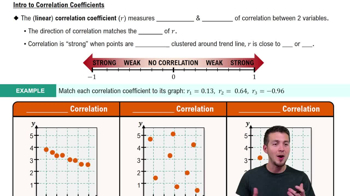
Understand the concept of correlation: Correlation measures the strength and direction of a linear relationship between two variables. It is represented by the correlation coefficient, which ranges from -1 to 1.
Recognize the meaning of 'correlation does not imply causation': This phrase means that just because two variables are correlated (i.e., they move together in some way), it does not necessarily mean that one variable causes the other to change. Correlation only indicates a relationship, not a cause-and-effect connection.
Consider external factors: Correlation can exist due to a third variable (confounding variable) that influences both variables, or it can be purely coincidental. For example, ice cream sales and drowning incidents are correlated, but the underlying factor is the season (summer), which increases both activities.
Identify examples of correlated variables without causation: A common example is the number of movies Nicolas Cage appears in and the number of swimming pool drownings in a given year. These two variables may show correlation, but there is no causal relationship between them.
Reflect on the importance of statistical analysis: To establish causation, researchers must conduct controlled experiments or use advanced statistical methods to rule out confounding variables and demonstrate a direct cause-and-effect relationship.
Verified video answer for a similar problem:This video solution was recommended by our tutors as helpful for the problem above
Video duration:
3mPlay a video:
Was this helpful?
Key Concepts
Here are the essential concepts you must grasp in order to answer the question correctly.
Correlation
Correlation refers to a statistical measure that describes the extent to which two variables change together. A positive correlation indicates that as one variable increases, the other tends to increase as well, while a negative correlation indicates that as one variable increases, the other tends to decrease. However, correlation does not provide information about the nature of the relationship between the variables.
Recommended video:
Guided course
Correlation Coefficient
Causation
Causation implies a direct cause-and-effect relationship between two variables, meaning that changes in one variable directly result in changes in another. Establishing causation typically requires controlled experiments or longitudinal studies to rule out other influencing factors. It is crucial to differentiate causation from correlation to avoid incorrect conclusions about the nature of relationships between variables.
Recommended video:
Guided course
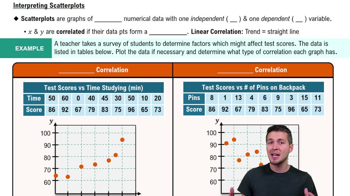
Scatterplots & Intro to Correlation
Spurious Correlation
A spurious correlation occurs when two variables appear to be related to each other but are actually influenced by a third variable or are coincidental. For example, ice cream sales and drowning incidents may show a positive correlation during summer months, but both are influenced by the warmer weather rather than one causing the other. Recognizing spurious correlations is essential to avoid misleading interpretations of data.
Recommended video:
Guided course
Correlation Coefficient
Watch next
Master Scatterplots & Intro to Correlation with a bite sized video explanation from Patrick
Start learningRelated Videos
Related Practice
Textbook Question
14
views
