You Explain It! Percentiles Explain the meaning of the following percentiles. Source: National Center for Health Statistics. a. The 5th percentile of the weight of males 36 months of age is 12.0 kg. b. The 95th percentile of the length of newborn females is 53.8 cm.
Table of contents
- 1. Intro to Stats and Collecting Data1h 14m
- 2. Describing Data with Tables and Graphs1h 55m
- 3. Describing Data Numerically2h 5m
- 4. Probability2h 16m
- 5. Binomial Distribution & Discrete Random Variables3h 6m
- 6. Normal Distribution and Continuous Random Variables2h 11m
- 7. Sampling Distributions & Confidence Intervals: Mean3h 23m
- Sampling Distribution of the Sample Mean and Central Limit Theorem19m
- Distribution of Sample Mean - Excel23m
- Introduction to Confidence Intervals15m
- Confidence Intervals for Population Mean1h 18m
- Determining the Minimum Sample Size Required12m
- Finding Probabilities and T Critical Values - Excel28m
- Confidence Intervals for Population Means - Excel25m
- 8. Sampling Distributions & Confidence Intervals: Proportion1h 25m
- 9. Hypothesis Testing for One Sample3h 29m
- 10. Hypothesis Testing for Two Samples4h 50m
- Two Proportions1h 13m
- Two Proportions Hypothesis Test - Excel28m
- Two Means - Unknown, Unequal Variance1h 3m
- Two Means - Unknown Variances Hypothesis Test - Excel12m
- Two Means - Unknown, Equal Variance15m
- Two Means - Unknown, Equal Variances Hypothesis Test - Excel9m
- Two Means - Known Variance12m
- Two Means - Sigma Known Hypothesis Test - Excel21m
- Two Means - Matched Pairs (Dependent Samples)42m
- Matched Pairs Hypothesis Test - Excel12m
- 11. Correlation1h 24m
- 12. Regression1h 50m
- 13. Chi-Square Tests & Goodness of Fit2h 21m
- 14. ANOVA1h 57m
3. Describing Data Numerically
Percentiles & Quartiles
Problem 3.4.15
Textbook Question
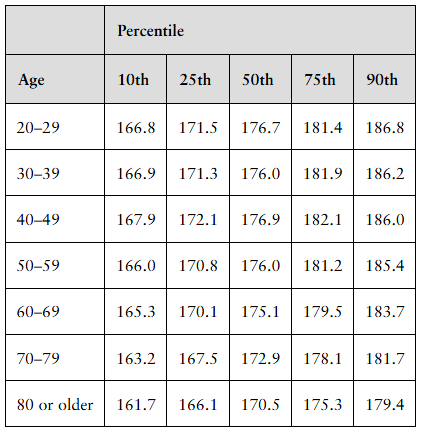
[NW] You Explain It! Percentiles Explain the meaning of the following percentiles. Source: Advance Data from Vital and Health Statistics. a. The 15th percentile of the head circumference of males 3 to 5 months of age is 41.0 cm. b. The 90th percentile of the waist circumference of females 2 years of age is 52.7 cm. c, Anthropometry involves the measurement of the human body. One goal of these measurements is to assess how body measurements may be changing over time. The following table represents the standing height of males aged 20 years or older for various age groups. Based on the percentile measurements of the different age groups, what might you conclude?

Verified step by step guidance1
Step 1: Understand the meaning of a percentile. The pth percentile is the value below which p% of the data falls. For example, the 15th percentile means 15% of the measurements are below that value.
Step 2: For part (a), interpret the 15th percentile of head circumference for males aged 3 to 5 months as the value below which 15% of the head circumference measurements fall, which is 41.0 cm.
Step 3: For part (b), interpret the 90th percentile of waist circumference for females aged 2 years as the value below which 90% of the waist circumference measurements fall, which is 52.7 cm.
Step 4: For part (c), analyze the table showing standing height percentiles for males aged 20 years or older across different age groups. Observe how the percentile values change as age increases, noting any trends such as decreases in height percentiles with increasing age.
Step 5: Conclude that the data suggests a trend where standing height tends to decrease with age among males 20 years and older, as seen by the gradual decline in percentile values from the 20–29 age group to the 80 or older group.
Verified video answer for a similar problem:This video solution was recommended by our tutors as helpful for the problem above
Video duration:
2mPlay a video:
Was this helpful?
Key Concepts
Here are the essential concepts you must grasp in order to answer the question correctly.
Percentiles
Percentiles indicate the relative standing of a value within a data set by showing the percentage of data points below that value. For example, the 15th percentile means 15% of the data falls below that measurement. Percentiles help interpret individual measurements in the context of a population.
Recommended video:
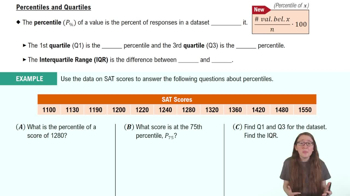
Percentiles and Quartiles
Anthropometric Measurements
Anthropometry involves measuring physical dimensions of the human body, such as height, head circumference, and waist circumference. These measurements are used to assess growth, health, and changes over time in populations, providing important data for medical and nutritional studies.
Recommended video:
Guided course
Visualizing Qualitative vs. Quantitative Data
Interpreting Percentile Tables Over Age Groups
Percentile tables across age groups show how measurements like height vary with age. Observing trends in percentiles helps identify patterns such as growth, decline, or stability. For example, a decrease in height percentiles with increasing age may indicate age-related height loss in the population.
Recommended video:
Percentiles and Quartiles
Watch next
Master Percentiles and Quartiles with a bite sized video explanation from Patrick
Start learningRelated Videos
Related Practice
Textbook Question
8
views