
Ch. 4 - Discrete Probability Distributions
Larson - Elementary Statistics: Picturing the World 8th Edition
Larson8th EditionElementary Statistics: Picturing the WorldISBN: 9780137493470Not the one you use?Change textbook
Chapter 4, Problem 4.1.6

True or False? In Exercises 5–8, determine whether the statement is true or false. If it is false, rewrite it as a true statement.


For a random variable x, the word random indicates that the value of x is determined by chance.

Verified step by step guidance
1
Understand the definition of a random variable: A random variable is a numerical outcome of a random phenomenon, and its value is determined by chance.
Analyze the statement: 'For a random variable x, the word random indicates that the value of x is determined by chance.'
Compare the statement to the definition of a random variable. The key aspect is whether the value of x being determined by chance aligns with the definition.
Determine if the statement is true or false based on the comparison. If it matches the definition, the statement is true. If not, identify the discrepancy.
If the statement is false, rewrite it to align with the correct definition of a random variable, ensuring clarity and accuracy.

Verified video answer for a similar problem:

This video solution was recommended by our tutors as helpful for the problem above.
Video duration:
1m
Was this helpful?

Key Concepts

Here are the essential concepts you must grasp in order to answer the question correctly.

Random Variable

A random variable is a numerical outcome of a random phenomenon. It can take on different values, each associated with a probability, reflecting the uncertainty inherent in the process. Random variables are classified into discrete (specific values) and continuous (any value within a range) types, which are fundamental in probability and statistics.
Recommended video:
Guided course
07:09
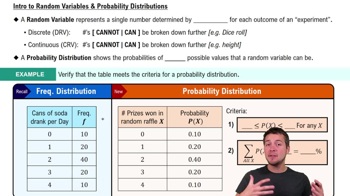
Intro to Random Variables & Probability Distributions

Probability

Probability is a measure of the likelihood that a particular event will occur, expressed as a number between 0 and 1. In the context of random variables, it quantifies the chance of each possible outcome. Understanding probability is essential for interpreting random variables and making predictions based on statistical data.
Recommended video:
5:37
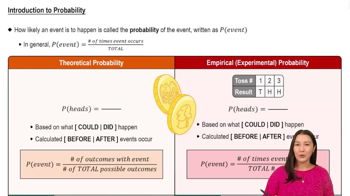
Introduction to Probability

Determinism vs. Randomness

Determinism refers to the idea that events are determined by preceding causes, while randomness implies that outcomes are influenced by chance. In statistics, recognizing the distinction between deterministic and random processes is crucial for accurately modeling and analyzing data, particularly when dealing with random variables.
Recommended video:
Guided course
06:14
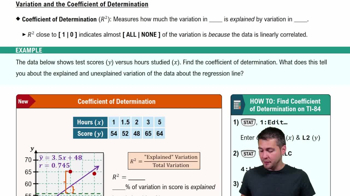
Coefficient of Determination
Related Practice
Textbook Question

Finding an Expected Value In Exercises 37 and 38, find the expected value E(x) to the player for one play of the game. If x is the gain to a player in a game of chance, then E(x) is usually negative. This value gives the average amount per game the player can expect to lose.


A high school basketball team is selling \$10 raffle tickets as part of a fund-raising program. The first prize is a trip to the Bahamas valued at \$5460, and the second prize is a weekend ski package valued at \$496. The remaining 18 prizes are \$100 gas cards. The number of tickets sold is 3500.

119
views
Textbook Question

Baseball There were 116 World Series from 1903 to 2020. Use the probability distribution in Exercise 30 to find the number of World Series that had 4, 5, 6, 7, and 8 games. Find the population mean, variance, and standard deviation of the data using the traditional definitions. Compare to your answers in Exercise 30.

77
views
Textbook Question

In Exercises 1–4, find the indicated probability using the geometric distribution.


Find P(5) when p = 0.09

135
views
Textbook Question

Finding Binomial Probabilities In Exercises 19–26, find the indicated probabilities. If convenient, use technology or Table 2 in Appendix B.


Penalty Kicks Argentine soccer player Lionel Messi converts 78% of his penalty kicks. Suppose Messi takes six penalty kicks next season. Find the probability that the number he converts is (a) exactly six, (b) at most three, and (c) more than three. (Source: Transfermarkt)

99
views
Textbook Question

Graphical Analysis In Exercises 9–12, determine whether the graph on the number line represents a discrete random variable or a continuous random variable. Explain your reasoning.


The attendance at concerts for a rock group

95
views
Textbook Question

Constructing and Graphing Binomial Distributions In Exercises 27–30, (a) construct a binomial distribution, (b) graph the binomial distribution using a histogram and describe its shape, and (c) identify any values of the random variable x that you would consider unusual. Explain your reasoning.


College Acceptance Pennsylvania State University accepts 49% of applicants. You randomly select seven Pennsylvania State University applicants. The random variable represents the number who are accepted. (Source: US News & World Report)

133
views