
You are negotiating a contract for the Players Association of the NBA. Which measure of central tendency will you use to support your claim that the average player’s salary needs to be increased? Why? As the chief negotiator for the owners, which measure would you use to refute the claim made by the Players Association?
Table of contents
- 1. Intro to Stats and Collecting Data1h 14m
- 2. Describing Data with Tables and Graphs1h 55m
- 3. Describing Data Numerically2h 5m
- 4. Probability2h 16m
- 5. Binomial Distribution & Discrete Random Variables3h 6m
- 6. Normal Distribution and Continuous Random Variables2h 11m
- 7. Sampling Distributions & Confidence Intervals: Mean3h 23m
- Sampling Distribution of the Sample Mean and Central Limit Theorem19m
- Distribution of Sample Mean - Excel23m
- Introduction to Confidence Intervals15m
- Confidence Intervals for Population Mean1h 18m
- Determining the Minimum Sample Size Required12m
- Finding Probabilities and T Critical Values - Excel28m
- Confidence Intervals for Population Means - Excel25m
- 8. Sampling Distributions & Confidence Intervals: Proportion1h 25m
- 9. Hypothesis Testing for One Sample3h 29m
- 10. Hypothesis Testing for Two Samples4h 50m
- Two Proportions1h 13m
- Two Proportions Hypothesis Test - Excel28m
- Two Means - Unknown, Unequal Variance1h 3m
- Two Means - Unknown Variances Hypothesis Test - Excel12m
- Two Means - Unknown, Equal Variance15m
- Two Means - Unknown, Equal Variances Hypothesis Test - Excel9m
- Two Means - Known Variance12m
- Two Means - Sigma Known Hypothesis Test - Excel21m
- Two Means - Matched Pairs (Dependent Samples)42m
- Matched Pairs Hypothesis Test - Excel12m
- 11. Correlation1h 24m
- 12. Regression1h 50m
- 13. Chi-Square Tests & Goodness of Fit2h 21m
- 14. ANOVA1h 57m
3. Describing Data Numerically
Mode
Problem 5.CRE.1cd
Textbook Question
Planets The planets of the solar system have the numbers of moons listed below in order from the sun. (Pluto is not included because it was uninvited from the solar system party in 2006.) Include appropriate units whenever relevant.
0 0 1 2 17 28 21 8
c. Find the mode.
d. Find the range.
Verified step by step guidance1
Step 1: To find the mode, identify the number(s) of moons that appear most frequently in the dataset. The dataset is: 0, 0, 1, 2, 17, 28, 21, 8.
Step 2: Count the frequency of each unique value in the dataset. For example, count how many times 0 appears, how many times 1 appears, and so on.
Step 3: The mode is the value(s) with the highest frequency. If no value repeats, the dataset has no mode. If multiple values have the same highest frequency, the dataset is multimodal.
Step 4: To find the range, subtract the smallest value in the dataset from the largest value. Identify the smallest value (minimum) and the largest value (maximum) in the dataset.
Step 5: Compute the range using the formula: . Ensure the result includes appropriate units (e.g., number of moons).
Verified video answer for a similar problem:This video solution was recommended by our tutors as helpful for the problem above
Video duration:
1mPlay a video:
Was this helpful?
Key Concepts
Here are the essential concepts you must grasp in order to answer the question correctly.
Mode
The mode is the value that appears most frequently in a data set. In the context of the number of moons for the planets listed, the mode helps identify which number of moons is most common among the planets. If no number repeats, the data set is said to have no mode. Understanding how to calculate the mode is essential for summarizing data effectively.
Recommended video:
Guided course
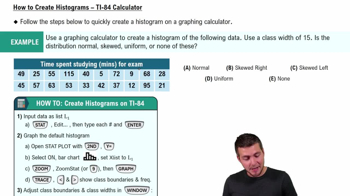
How to Create Histogram - TI-84 Calculator
Range
The range is a measure of dispersion that indicates the difference between the highest and lowest values in a data set. It provides insight into the spread of the data, showing how varied the number of moons is among the planets. To calculate the range, subtract the smallest value from the largest value. This concept is crucial for understanding the variability in the data.
Recommended video:
Guided course
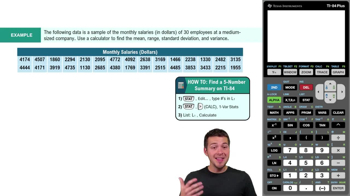
Find 5-Number Summary - TI-84 Calculator Example 1
Data Set
A data set is a collection of related values or observations, often organized in a structured format. In this case, the data set consists of the number of moons for each planet in the solar system. Analyzing a data set involves identifying patterns, calculating statistics like mode and range, and drawing conclusions based on the data. Understanding data sets is fundamental in statistics.
Recommended video:
Guided course
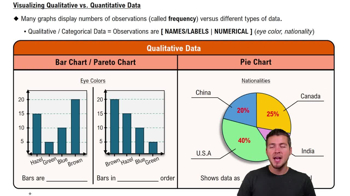
Visualizing Qualitative vs. Quantitative Data
Related Videos
Related Practice
Textbook Question
9
views
