
The following data represent the time (in minutes) students spent working their Section 1.1 homework from Sullivan’s College Algebra course (based on time logged into MyLabMath). Draw a stem-and-leaf diagram of the data and comment on the shape of the distribution.
Table of contents
- 1. Intro to Stats and Collecting Data1h 14m
- 2. Describing Data with Tables and Graphs1h 55m
- 3. Describing Data Numerically2h 5m
- 4. Probability2h 16m
- 5. Binomial Distribution & Discrete Random Variables3h 6m
- 6. Normal Distribution and Continuous Random Variables2h 11m
- 7. Sampling Distributions & Confidence Intervals: Mean3h 23m
- Sampling Distribution of the Sample Mean and Central Limit Theorem19m
- Distribution of Sample Mean - Excel23m
- Introduction to Confidence Intervals15m
- Confidence Intervals for Population Mean1h 18m
- Determining the Minimum Sample Size Required12m
- Finding Probabilities and T Critical Values - Excel28m
- Confidence Intervals for Population Means - Excel25m
- 8. Sampling Distributions & Confidence Intervals: Proportion1h 25m
- 9. Hypothesis Testing for One Sample3h 29m
- 10. Hypothesis Testing for Two Samples4h 50m
- Two Proportions1h 13m
- Two Proportions Hypothesis Test - Excel28m
- Two Means - Unknown, Unequal Variance1h 3m
- Two Means - Unknown Variances Hypothesis Test - Excel12m
- Two Means - Unknown, Equal Variance15m
- Two Means - Unknown, Equal Variances Hypothesis Test - Excel9m
- Two Means - Known Variance12m
- Two Means - Sigma Known Hypothesis Test - Excel21m
- Two Means - Matched Pairs (Dependent Samples)42m
- Matched Pairs Hypothesis Test - Excel12m
- 11. Correlation1h 24m
- 12. Regression1h 50m
- 13. Chi-Square Tests & Goodness of Fit2h 21m
- 14. ANOVA1h 57m
2. Describing Data with Tables and Graphs
Stemplots (Stem-and-Leaf Plots)
Problem 2.2.42a
Textbook Question
Yoga Classes The data sets at the left show the ages of all participants in two yoga classes.

a. Make a back-to-back stem-and-leaf plot as described in Exercise 41 to display the data.
Verified step by step guidance1
Step 1: Understand the concept of a back-to-back stem-and-leaf plot. This type of plot is used to compare two data sets side by side. The 'stem' represents the leading digits (e.g., tens place), while the 'leaves' represent the trailing digits (e.g., ones place). The stems are shared between the two data sets, with one set's leaves displayed to the left and the other's to the right.
Step 2: Organize the data for both classes into stems and leaves. For example, for the 3:00 P.M. class, the ages include numbers like 40, 60, 73, etc. The stems will be the tens digits (e.g., 4, 6, 7, etc.), and the leaves will be the ones digits (e.g., 0, 0, 3, etc.). Similarly, for the 8:00 P.M. class, organize the ages into stems and leaves.
Step 3: Create a shared stem column. Write the stems in ascending order (e.g., 1, 2, 3, etc.) in the center of the plot. The leaves for the 3:00 P.M. class will be displayed to the left of the stems, and the leaves for the 8:00 P.M. class will be displayed to the right.
Step 4: Populate the back-to-back stem-and-leaf plot. For each stem, list the leaves for the 3:00 P.M. class on the left side and the leaves for the 8:00 P.M. class on the right side. Ensure the leaves are ordered numerically within each stem.
Step 5: Review the completed plot for accuracy. Verify that all data points are included and correctly placed. The plot should visually compare the distribution of ages between the two yoga classes, allowing for easy interpretation of differences or similarities.
Verified video answer for a similar problem:This video solution was recommended by our tutors as helpful for the problem above
Video duration:
2mPlay a video:
Was this helpful?
Key Concepts
Here are the essential concepts you must grasp in order to answer the question correctly.
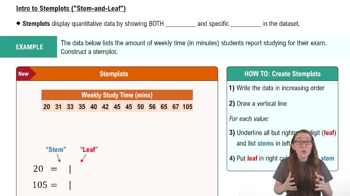
Stem-and-Leaf Plot
A stem-and-leaf plot is a method of displaying quantitative data in a graphical format, similar to a histogram, to retain the original data values while showing their distribution. Each number is split into a 'stem' (the leading digit or digits) and a 'leaf' (the trailing digit). This allows for easy visualization of the data's shape and helps identify the distribution, central tendency, and spread.
Recommended video:
Creating Stemplots
Data Distribution
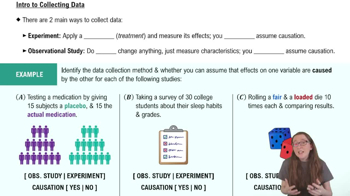
Data distribution refers to how values are spread or arranged across a dataset. Understanding the distribution helps in identifying patterns, trends, and anomalies within the data. Common distributions include normal, skewed, and uniform distributions, which can be visualized using plots like histograms or stem-and-leaf plots, providing insights into the data's characteristics.
Recommended video:
Introduction to Collecting Data
Comparative Analysis
Comparative analysis involves evaluating two or more datasets to identify similarities, differences, and trends. In the context of the yoga classes, comparing the ages of participants in the 3:00 P.M. and 8:00 P.M. classes can reveal insights about the demographics of each class. This analysis can be effectively visualized using back-to-back stem-and-leaf plots, facilitating a clear comparison of the two groups.
Recommended video:
Guided course
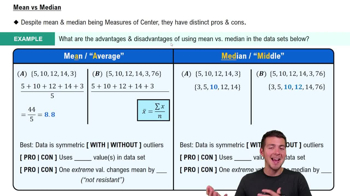
Comparing Mean vs. Median
Related Videos
Related Practice
Textbook Question
7
views
