[DATA] Putting It Together: Glide Testing You are a passenger in a single-propeller-driven aircraft that experiences engine failure in the middle of a flight. The pilot wants to maximize the distance that the plane can glide to increase the likelihood of finding a safe place to land. To accomplish this goal, should the pilot allow the propeller to “windmill” or should the pilot force the propeller to stop? To obtain the data needed to answer the research question, a pilot climbed to 8000 feet at a speed of 60 knots and then killed the engine with the propeller either windmilling or stopped. Because the time to descend is directly proportional to glide distance, the time to descend to 7200 feet was recorded in seconds and used as a proxy for glide distance. The design called for randomly choosing the order in which the propeller would windmill or be stopped. The data in the table represent the time to descend 800 feet for each of 27 trials. Note: Visit www.aceaerobaticschool.com to see footage of this scenario. c. Explain why blinding is not possible for this experiment.
Verified step by step guidance
1
Understand the concept of blinding in experiments: Blinding means that the participants or the experimenters do not know which treatment is being applied to prevent bias in the results.
Consider the nature of the experiment: The pilot is directly controlling whether the propeller is windmilling or stopped, and this condition is physically apparent during the flight.
Recognize that the pilot must know the propeller condition to operate the aircraft safely and to record the descent time accurately, so the pilot cannot be blinded to the treatment.
Acknowledge that the passenger or observer can also likely hear or feel the difference between a windmilling and a stopped propeller, making it impossible to blind them as well.
Conclude that because the treatment involves a physical and operational difference that cannot be hidden from the pilot or observers, blinding is not possible in this experiment.
Verified video answer for a similar problem:
This video solution was recommended by our tutors as helpful for the problem above
Video duration:
1m
Play a video:
0 Comments
Key Concepts
Here are the essential concepts you must grasp in order to answer the question correctly.
Blinding in Experiments
Blinding is a technique used in experiments to prevent bias by keeping participants, researchers, or both unaware of which treatment is being administered. It helps ensure that expectations do not influence the results. In this glide testing experiment, blinding is not possible because the pilot can physically observe whether the propeller is windmilling or stopped, making it impossible to conceal the treatment condition.
A paired design involves comparing two treatments on the same experimental unit or matched units to control for variability. Here, each trial records descent times for both windmilling and stopped propeller conditions on the same flight, allowing direct comparison and reducing the effect of external factors like weather or pilot behavior.
Randomization is the process of randomly assigning the order of treatments to reduce bias and confounding variables. In this experiment, the order in which the propeller is windmilling or stopped is randomly chosen to ensure that time-related factors or pilot fatigue do not systematically affect one condition more than the other.

 1:20 minutes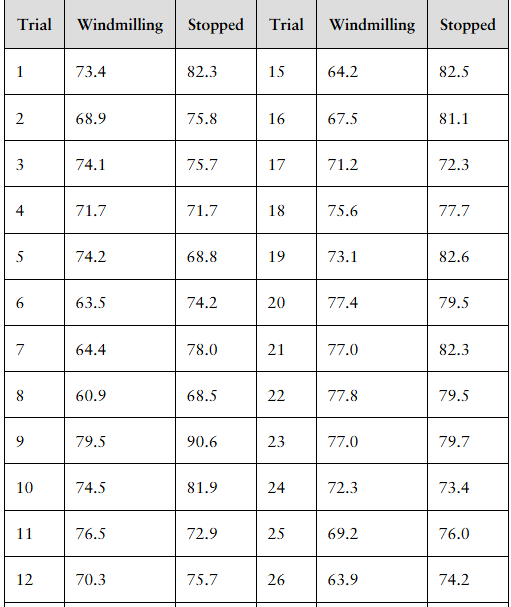

 Verified step by step guidance
 06:00
06:00