
According to the National Center for Health Statistics, a 10-year-old male whose height is 53.5 inches has a height that is at the 15th percentile. Explain what this means.
Table of contents
- 1. Intro to Stats and Collecting Data1h 14m
- 2. Describing Data with Tables and Graphs1h 55m
- 3. Describing Data Numerically2h 5m
- 4. Probability2h 16m
- 5. Binomial Distribution & Discrete Random Variables3h 6m
- 6. Normal Distribution and Continuous Random Variables2h 11m
- 7. Sampling Distributions & Confidence Intervals: Mean3h 23m
- Sampling Distribution of the Sample Mean and Central Limit Theorem19m
- Distribution of Sample Mean - Excel23m
- Introduction to Confidence Intervals15m
- Confidence Intervals for Population Mean1h 18m
- Determining the Minimum Sample Size Required12m
- Finding Probabilities and T Critical Values - Excel28m
- Confidence Intervals for Population Means - Excel25m
- 8. Sampling Distributions & Confidence Intervals: Proportion1h 25m
- 9. Hypothesis Testing for One Sample3h 29m
- 10. Hypothesis Testing for Two Samples4h 50m
- Two Proportions1h 13m
- Two Proportions Hypothesis Test - Excel28m
- Two Means - Unknown, Unequal Variance1h 3m
- Two Means - Unknown Variances Hypothesis Test - Excel12m
- Two Means - Unknown, Equal Variance15m
- Two Means - Unknown, Equal Variances Hypothesis Test - Excel9m
- Two Means - Known Variance12m
- Two Means - Sigma Known Hypothesis Test - Excel21m
- Two Means - Matched Pairs (Dependent Samples)42m
- Matched Pairs Hypothesis Test - Excel12m
- 11. Correlation1h 24m
- 12. Regression1h 50m
- 13. Chi-Square Tests & Goodness of Fit2h 21m
- 14. ANOVA1h 57m
3. Describing Data Numerically
Percentiles & Quartiles
Problem 2.5.32
Textbook Question
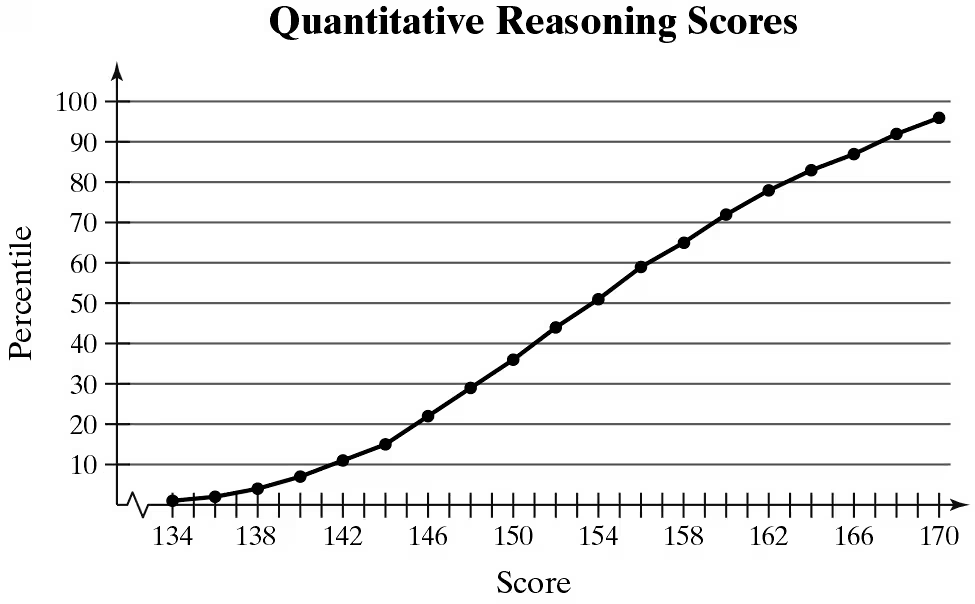
Interpreting Percentiles In Exercises 29–32, use the ogive, which represents the cumulative frequency distribution for quantitative reasoning scores on the Graduate Record Examination in a recent range of years. (Adapted from Educational Testing Service)

What percentile is a score of 170? How should you interpret this?
Verified step by step guidance1
Step 1: Understand the ogive graph. An ogive is a cumulative frequency graph that shows the percentage of data points below a certain value. The x-axis represents the scores, and the y-axis represents the percentiles.
Step 2: Locate the score of 170 on the x-axis of the graph. Draw a vertical line from this point upward until it intersects the curve.
Step 3: From the point of intersection, draw a horizontal line to the y-axis. This will give the corresponding percentile for the score of 170.
Step 4: Interpret the percentile value. The percentile indicates the percentage of test-takers who scored below 170. For example, if the percentile is 95, it means 95% of test-takers scored below 170.
Step 5: Use this information to understand the relative performance. A high percentile (e.g., 95th) suggests that the score of 170 is better than most test-takers, placing the individual in the top 5%.
Verified video answer for a similar problem:This video solution was recommended by our tutors as helpful for the problem above
Video duration:
1mPlay a video:
Was this helpful?
Key Concepts
Here are the essential concepts you must grasp in order to answer the question correctly.
Percentiles
A percentile is a statistical measure that indicates the value below which a given percentage of observations fall. For example, if a score is at the 70th percentile, it means that 70% of the scores are below that value. This concept is crucial for interpreting individual scores in the context of a larger dataset, such as standardized test results.
Recommended video:
Percentiles and Quartiles
Ogive
An ogive is a graph that represents the cumulative frequency of a dataset. It is constructed by plotting the cumulative frequency against the upper boundaries of the classes. In the context of the question, the ogive allows us to visually determine the percentile rank of a specific score, such as 170, by locating it on the x-axis and reading the corresponding percentile on the y-axis.
Cumulative Frequency
Cumulative frequency is the running total of frequencies in a dataset, showing how many observations fall below a particular value. It is essential for understanding the distribution of scores and is used to create the ogive. By analyzing cumulative frequency, one can determine how a specific score compares to others in the dataset, aiding in the interpretation of percentiles.
Recommended video:
Creating Frequency Polygons
Watch next
Master Percentiles and Quartiles with a bite sized video explanation from Patrick
Start learningRelated Videos
Related Practice
Textbook Question
6
views
